
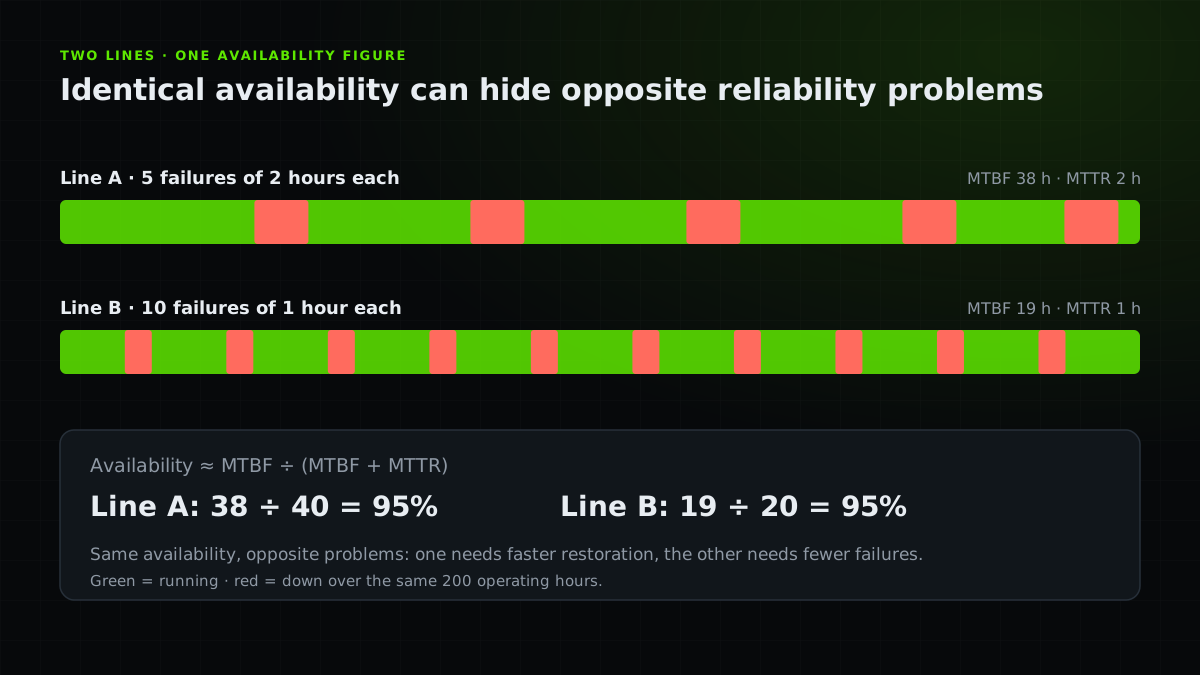
MTBF is the average operating time between failures. MTTR is the average time to restore equipment after a failure. Availability ≈ MTBF ÷ (MTBF + MTTR). A line with 5 failures of 2 hours in 200 hours has MTBF 38 h, MTTR 2 h and 95% availability. So does a line with 10 failures of 1 hour, but it needs fewer failures, not faster repair. OEE availability is broader: it counts all time lost, not only failures.
Clear formulas for MTBF, MTTR and availability
Two lines with the same availability and opposite problems
How reliability metrics differ from OEE availability
The definitions
MTBF, mean time between failures, describes how often equipment fails: total operating time divided by the number of failures. It is a frequency and reliability measure. MTTR, mean time to repair or restore, describes how long a failure lasts: total repair time divided by the number of failures. It is a maintainability measure.
In the simple constant-failure-rate model that NIST’s engineering handbook uses for repairable equipment, MTBF is the reciprocal of the failure rate. Be explicit about what counts as a failure, whether waiting time for parts or people is included in repair time, and whether MTBF uses operating time or calendar time. Different definitions produce different numbers.
A steady-state approximation. It counts failures only, not planned stops, slow running or rejects.
Same availability, opposite problems
Take two lines observed over 200 operating hours. Line A fails 5 times and each repair takes 2 hours: 190 hours of uptime and 10 hours of repair, so MTBF is 190 ÷ 5 = 38 hours and MTTR is 2 hours. Line B fails 10 times and each repair takes 1 hour: MTBF is 19 hours and MTTR is 1 hour.
Both lines are available 95% of the time: 38 ÷ 40 and 19 ÷ 20. The problems are opposite. Line A needs faster restoration, through spares, diagnostics and response. Line B needs fewer failures, through root-cause work and better design or maintenance.
How these differ from OEE availability
OEE availability is the share of planned production time that the equipment ran. It includes every stop above the recording threshold: failures, but also changeovers, material shortages, waiting for operators and quality holds. MTBF and MTTR describe failures only.
That is why a line can have excellent MTBF and MTTR and still have poor OEE availability. Read OEE formula and six big losses for how availability fits into the OEE calculation.
| Metric | Measures | Answers |
|---|---|---|
| MTBF | Average operating time between failures | How reliable is the equipment? |
| MTTR | Average time to restore after a failure | How quickly do we recover? |
| OEE availability | Share of planned time the line ran | How much production time was lost, for any reason? |
When these metrics lie to you
A line can improve MTBF, worsen MTTR and leave throughput unchanged. Averages also hide shape: 20 two-minute stops and one two-hour breakdown average about 7.6 minutes per event, a figure that describes none of them. Reliability metrics only matter when tied to operational consequence, so ask which failures reduce output at the constraint.
Track failure events with the origin and impact separated, as described in production downtime tracking, and rank them with a downtime Pareto.
- Count failures
Define what a failure is and record each one with start and end times.
- Split the time
Separate operating time, repair time and waiting time.
- Read the pattern
Is the loss driven by frequency (MTBF) or duration (MTTR)?
- Choose the lever
Fewer failures needs root-cause work. Shorter repairs need spares, skills and diagnosis.
- Check the consequence
Confirm the failures affect the constraint before prioritizing them.
Where prediction fits
Predictive maintenance tries to raise MTBF by acting before failure and to cut MTTR by planning the repair. It needs confirmed failure records to learn from, which is why clean event data comes first.
Practical checklist
- Define what counts as a failure and stick to it.
- Use operating time, not calendar time, for MTBF.
- Decide whether waiting time is part of MTTR.
- Report MTBF and MTTR together, never one alone.
- Check whether frequency or duration drives the loss.
- Separate failures from other causes of OEE availability loss.
- Prioritize failures that affect the constraint.
- Verify that improvements change output, not only the metric.
FAQ
Questions before you join
Sources and further reading
Authoritative references used to research and verify this guide.