

Calculate maintenance backlog in weeks by dividing estimated remaining labor hours by the crew hours available for that work each week. Report total backlog and ready-to-schedule backlog separately, using the same skill and scope boundaries. A job waiting for a spare part cannot fill tomorrow’s schedule just because its hours are counted. This fictional crew example shows the calculation, the effect of unavailable time and the checks that make a backlog useful rather than cosmetic.
Convert the work list into comparable labor weeks.
Separate ready work from parts, access and planning blockers.
Spot a trade bottleneck hidden inside the crew total.
Count remaining person-hours, not work orders
A two-person job lasting 4 hours requires 8 person-hours if both people are needed throughout. Ten small inspections and ten rebuilds can have the same job count and entirely different workloads. Estimate remaining effort rather than repeating the original estimate after work has already been done.
SMRP’s public metrics discussion expresses backlog as ready work divided by crew capacity. IBM distinguishes preparing the work from assigning who does it and when. Use those ideas together: an estimate, a readiness status and an available qualified crew are separate inputs.
Build the denominator from available crew hours
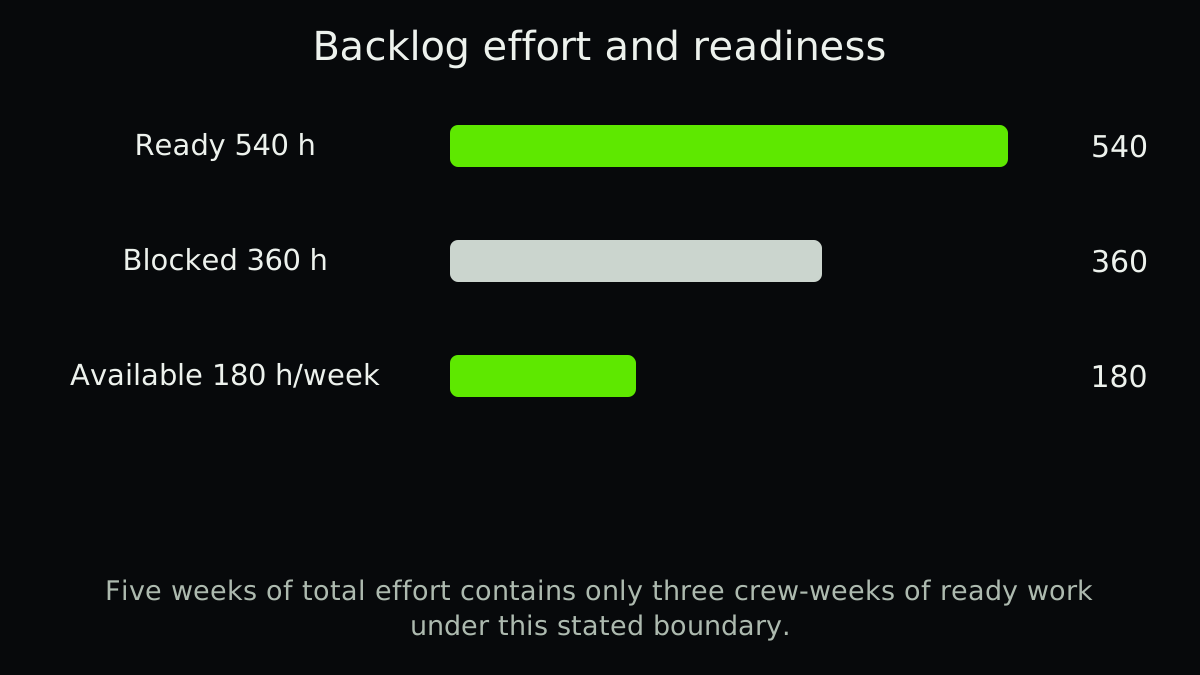
Our illustrative crew has 6 technicians at 40 hours each, giving 240 paid hours per week. Leave removes 24 hours, training 12 and fixed commitments outside this backlog 24. That leaves 180 hours for this defined work. These deductions are fictional inputs, not a recommended utilization target.
The backlog contains 900 remaining labor hours:540 ready and 360 blocked. Total backlog is 900/180 =5 weeks. Ready backlog is 540/180 =3 weeks. Blocked work represents 2 crew-weeks of effort, but it is not 2 weeks that the scheduler can necessarily fill.
Use the same crew, skill group, work scope and calendar basis in numerator and denominator. Zero available hours means the ratio is undefined.
| Input or result | Hours | Weeks at 180 h/week |
|---|---|---|
| Paid crew time | 240 | Not the available denominator |
| Unavailable or outside-scope commitments | 60 | Deducted once |
| Available for this backlog | 180/week | Denominator |
| Ready remaining work | 540 | 3 |
| Blocked remaining work | 360 | 2 |
| Total remaining work | 900 | 5 |
Check the craft that cannot borrow every spare hour
Suppose 120 of the 540 ready hours require an electrician, while the available electrician capacity is 30 hours per week. That subset is 4 weeks, even though the whole ready backlog is 3 weeks. Unqualified mechanical hours cannot be substituted into the electrical denominator.
Check whether the work also needs a shutdown, permit, special tool or shared contractor. Readiness is a defined checklist with a timestamp, not an optimistic label. A job can have parts on the shelf and still be unavailable because access has not been approved.
Show why work is blocked
Group blocked hours by the next action: missing scope, estimate, spare part, access, permit or approved job plan. Assign an owner to remove each blocker. Keep consequence and due need visible; sorting solely by age can leave important failures untreated.
Connect parts blockers to the critical spare parts review. Identify the exact missing item and its promised date in the work record. Keep work instructions and safe isolation under the site’s approved procedures.
- Validate the work list
Remove duplicates and record remaining scope, hours and consequence.
- Classify readiness
Check parts, skills, tooling, access and approved safety prerequisites.
- Calculate by crew and craft
Use available hours for the same workload and period.
- Resolve blockers and schedule
Assign the next unblock action, then place genuinely ready jobs into the schedule.
Reconcile changes instead of chasing a target number
If 100 hours of new work arrive and 160 hours are completed, an unchanged 900-hour opening backlog becomes 840 hours, or 4.67 weeks at 180 hours per week. Estimate revisions, cancelled work and scope transfers need separate lines. A falling total can reflect deleted estimates rather than more work finished.
There is no universal healthy backlog band for every plant. Risk, shutdown cycles, demand, crew mix and estimate quality matter. Pair weeks with age, overdue risk, readiness and schedule performance. Use MTBF and MTTR to study failures and restoration, not to replace planning evidence.
Make the next planning meeting shorter
Bring the jobs that changed status, the largest skill shortages and blockers needing a decision. A dashboard with 5 weeks of total backlog cannot tell a planner which permit to obtain today. The record should.
The download keeps paid hours, deductions, ready work and blocked work separate. Bring one blocked job to the next meeting with a named owner and a specific next action.
A related example from Abolfazl
Use a recurring conveyor fault to separate restoration from prevention.
In English, on founder Abolfazl’s personal blog. This is related reading, not an independent technical source.
Practical checklist
- Use remaining person-hours.
- Remove duplicate work orders.
- Define the crew and work scope.
- Deduct unavailable time once.
- Check readiness using explicit prerequisites.
- Calculate constrained crafts separately.
- Reconcile additions, completions and estimate changes.
- Keep risk and calendar access beside the weeks figure.
FAQ
FAQ
Sources and further reading
Authoritative references used to research and verify this guide.