
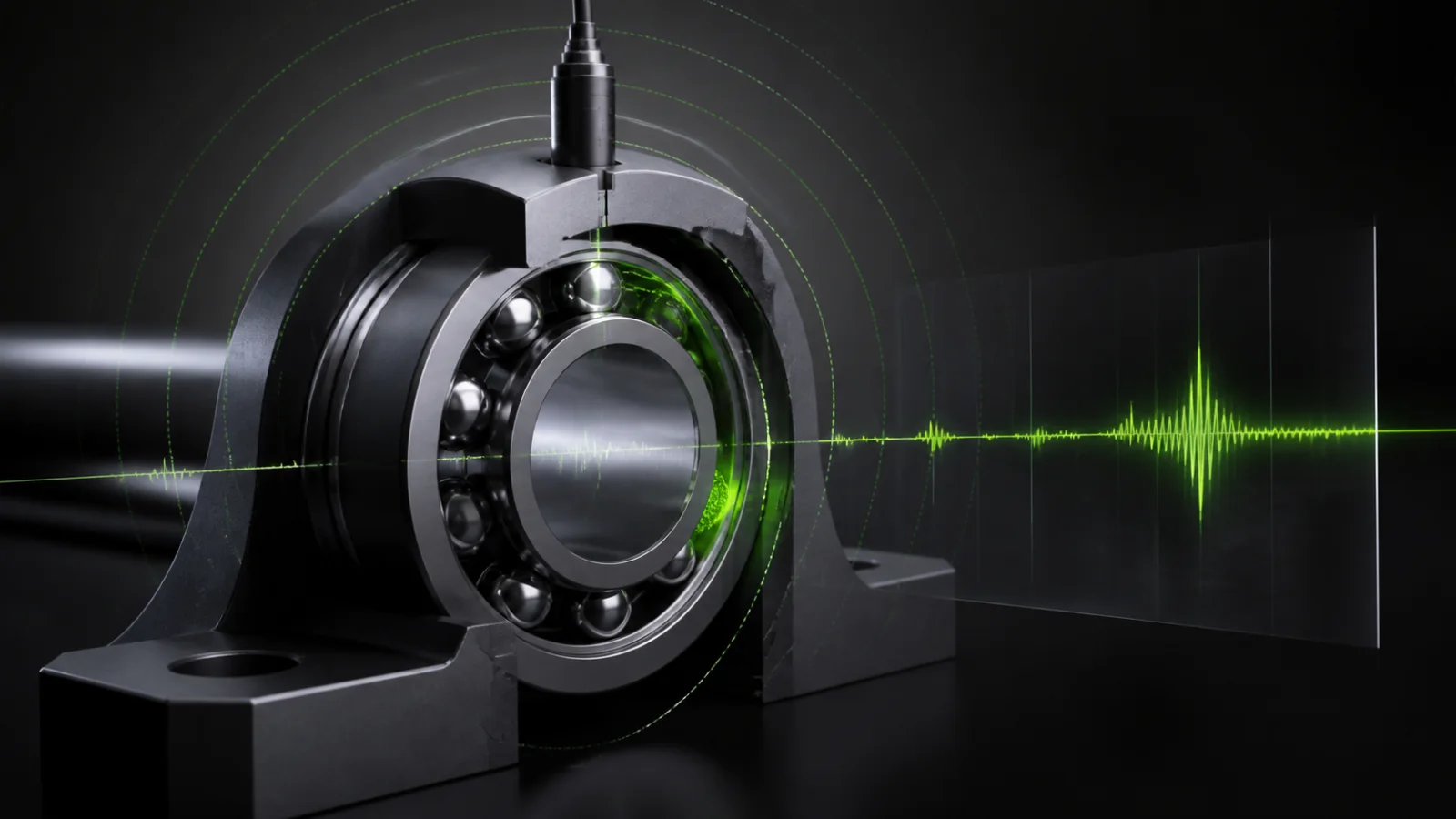
Predictive maintenance in manufacturing uses current and historical equipment-condition data to estimate developing failure or performance degradation, then supports a maintenance decision before unacceptable loss occurs. Unlike fixed-interval preventive maintenance, it responds to measured or forecast condition. A complete program needs more than an AI score: it needs trustworthy sensors, labeled maintenance evidence, a decision threshold, a feasible intervention, and proof that the action improves reliability and production outcomes.
Condition-aware warnings
Explainable failure evidence
Production-aware maintenance timing
Separate predictive, preventive, and condition-based maintenance
Reactive maintenance follows failure. Preventive maintenance acts on a calendar or usage interval. Condition-based maintenance acts when a measured indicator crosses a rule. Predictive maintenance estimates the future development of the condition or the remaining window for action.
Use the least complex method that improves the decision. A stable pressure limit may outperform a machine-learning model. Predictive methods earn their place when several signals interact, degradation depends on load or product, or the team needs earlier notice than a simple alarm provides.
- Failure mode and consequence
- Detectable degradation signature
- Useful warning horizon
- Maintenance action available within that horizon
Build a decision-ready data pipeline
Start from the failure mode, then select signals. Vibration, temperature, current, pressure, acoustics, lubrication, controller alarms, cycle time, and process quality can all matter. Add operating context such as speed, load, recipe, product, ambient condition, shift, and recent maintenance so normal changes are not mistaken for faults.
Synchronize clocks and asset identifiers across PLC, sensor, historian, CMMS, MES, and manual records. Preserve raw readings, transformations, missing-data flags, maintenance timestamps, replaced components, and confirmed findings. A model trained on vague work-order text will reproduce vague labels.
- Sensor values and sampling context
- Machine state, load, recipe, and product
- Alarm, stop, repair, inspection, and replacement history
- Failure confirmation and “healthy after intervention” evidence
Evaluate the model as an operating policy
Accuracy alone is not enough. False negatives can allow a costly failure; false positives can waste parts and planned downtime. Measure precision, recall, warning time, calibration, drift, and performance by machine and operating regime. Then evaluate the maintenance policy created by the threshold.
NIST research highlights comparing condition-monitoring algorithms not only by algorithm metrics but by manufacturing outcomes such as production quantity or quality. A slightly less accurate model may be better if its alerts arrive within a usable planning window.
Test maintenance timing in system context
An equipment-health prediction does not automatically identify the best intervention time. Consider spare parts, labor, access, safety, changeovers, buffers, downstream demand, and whether the asset is the current system constraint. Use simulation to compare “run,” “inspect,” “derate,” and “repair” policies under uncertainty.
Set clear escalation rules and let people review the evidence. High-risk decisions may require a physical inspection or redundant signal before shutdown. Record why an alert was accepted, deferred, or rejected so the policy can improve.
- Detect
Identify a trustworthy deviation from the expected condition.
- Diagnose
Link the signal to plausible failure modes and evidence.
- Forecast
Estimate the warning horizon with uncertainty.
- Plan
Compare intervention options against production and risk.
- Verify
Inspect the asset and measure whether the action prevented recurrence.
Pilot narrowly, then scale by repeatable value
Choose one consequential, detectable failure mode on a well-understood asset. Establish baseline downtime, maintenance cost, false alarms, quality loss, and production impact before the pilot. Run alerts in shadow mode first so the team can evaluate them without changing operations.
Scale only after the data pipeline, alert ownership, response workflow, cybersecurity controls, and value calculation are repeatable. Monitor model and sensor drift. A predictive-maintenance system that produces unowned alerts is only another dashboard.
A related example from Abolfazl
Use a recurring conveyor fault to separate restoration from prevention.
In English, on founder Abolfazl’s personal blog. This is related reading, not an independent technical source.
Practical checklist
- Choose a failure mode with a detectable degradation path.
- Define the decision, warning horizon, and available action.
- Add load, product, state, and maintenance context to sensor data.
- Create verified failure and healthy-condition labels.
- Evaluate false alarms, missed failures, warning time, and calibration.
- Test intervention timing against production, safety, and quality.
- Pilot in shadow mode and assign every alert an owner.
FAQ
FAQ
Sources and further reading
Authoritative references used to research and verify this guide.
- NISTMonitoring, Diagnostics and Prognostics for Manufacturing Operations
- NISTSimulation-Based Assessment of Condition Monitoring-Enabled Maintenance
- U.S. Department of EnergyOperations & Maintenance Best Practices Guide
- ISOISO 13374-1: Condition monitoring and diagnostics of machines
- NIST2026 Roadmap on Artificial Intelligence and Machine Learning for Smart Manufacturing