
Reliability-centered maintenance, or RCM, selects failure-management actions from the function required, the ways it can fail, the consequences and the feasibility of each task. Condition monitoring, scheduled work, failure-finding, redesign and an approved run-to-failure decision can serve different cases. The method needs more than an equipment criticality score. This fictional conveyor example shows how to examine a proposed monitoring interval without turning an assumed warning window into a safe site instruction.
Connect a maintenance task to a specific failure mode.
Check whether detection leaves enough time to respond.
Keep hidden protective failures separate from visible production stops.
Define the required function in its operating context
NASA’s RCM guide starts from what an asset must do in its operating context, then examines functional failure, failure modes and consequences. A conveyor’s name alone does not define its task. State the required movement, load, conditions and availability with the responsible operation.
Our illustrative conveyor must transfer a specified product between two stations. Loss of movement can stop production. A separate protective function can have a hidden failure even while the conveyor still moves. These need different analysis and authority; do not reduce them to one downtime ranking.
Choose among tasks by what they can actually prevent or reveal
A condition task looks for a detectable warning before functional failure. A scheduled restoration or replacement needs an applicable age or usage rationale. Failure-finding checks a hidden function. Some modes need redesign or an approved response after failure rather than another routine task.
The US Department of Energy presents RCM as a deliberate combination of maintenance approaches. That does not mean selecting every technology for every asset. Confirm the mechanism, consequences, task effectiveness and practical constraints.
| Failure question | Candidate action to assess | Evidence still needed |
|---|---|---|
| Detectable bearing deterioration? | Condition inspection | Warning detectability and response window |
| Demonstrated age-related wear? | Scheduled restoration or replacement | Applicable life behavior and task benefit |
| Hidden protective function failure? | Approved functional test | Test coverage, safety procedure and interval rationale |
| No suitable effective task? | Redesign or authorized failure response | Consequence and risk review |
Check the detection and response timeline
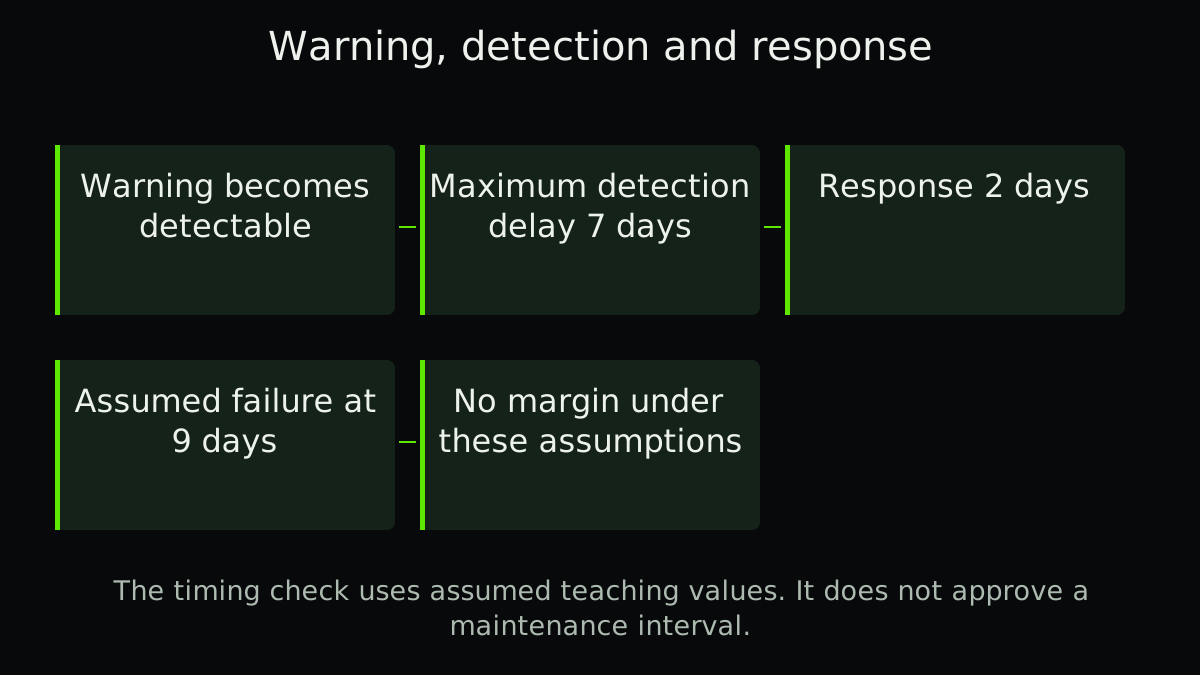
Assume, only for the fictional calculation, that a warning becomes detectable at least 9 days before functional failure and an approved repair restores the function within 2 days after detection. A 7-day inspection interval can consume 7 days before the next check and 2 more before restoration. That uses the entire assumed window.
The worst-case 9-day total leaves no margin for a missed check, uncertainty or a warning window shorter than assumed. A 2-day interval plus 2-day response would use 4 days, leaving 5 under the same assumptions. Neither interval is prescribed here; real window distributions, detection probability, consequences and approved procedures determine the decision.
Fictional 7+2 =9 days leaves zero margin in an assumed 9-day window. Detectability and uncertainty must be reviewed separately.
Assess the task before adding it to the schedule
Check access, measurement consistency, failure coverage, safe execution, labor and the effect of the task itself. Repeated intrusive work may introduce errors. Follow equipment-specific and site-approved safety processes rather than an article’s generic example.
Use FMEA to organize failure modes and critical spare parts to check response constraints. A high consequence warrants attention, but it does not prove that the proposed inspection can detect the relevant mechanism.
- State function and failure
Describe required performance and the specific way it can be lost.
- Review consequences
Separate safety, environmental, operational and hidden-function effects.
- Evaluate feasible actions
Check detection, timing, effectiveness and practical execution for each candidate.
- Approve and learn
Record authority, results, failures and the reason for revising the task.
Keep maintenance metrics in their supporting role
MTBF and MTTR describe failure occurrence and restoration under defined boundaries. They do not by themselves select a safe replacement age or an effective condition-monitoring interval.
Similarly, a predictive-maintenance model needs validation for the specific failure and decision. A high offline score cannot prove enough warning or successful restoration on the line.
Retain the reason for every selected task
A usable RCM record links function, mode, consequence, task choice, interval rationale, owner and review evidence. If the context changes, revisit that chain rather than preserving the interval because it has always appeared on the calendar.
The download includes the fictional timing assumptions and a blank task-decision record. For a real asset, ask who can support the warning-window estimate and who owns the response. Maintenance and safety decisions require competent site review.
A related example from Abolfazl
Use a recurring conveyor fault to separate restoration from prevention.
In English, on founder Abolfazl’s personal blog. This is related reading, not an independent technical source.
Practical checklist
- Define the function and operating context.
- Identify a specific functional failure.
- Review its mode and consequences.
- Separate hidden protective functions.
- Verify detectability and task coverage.
- Include response time and uncertainty.
- Use approved safety and maintenance procedures.
- Record the decision owner and review evidence.
FAQ
FAQ
Sources and further reading
Authoritative references used to research and verify this guide.