

Takt time = available production time ÷ customer demand. It is how often you must complete a unit to keep pace with demand. Cycle time is how long the work actually takes per unit. Lead time is how long an order takes to travel through the whole process. With 420 minutes and 210 units of demand, takt is 2 minutes. If the cycle is 2.4 minutes the cell is too slow, and lead time can still be measured in days.
Three formulas and one example that uses all of them
A clear rule for which clock answers which decision
The mistakes that turn takt into a machine speed target
The short version
Takt time tells you how frequently you need to complete a unit to match customer demand. Cycle time tells you how long the process takes to complete a unit or work cycle. Lead time tells you how long a unit or order spends moving through the process or value stream from start to finish.
They are related, but each supports a different decision: takt sets the pace the system must meet, cycle time tells you whether a station can meet it, and lead time shows how long the customer waits.
Use net available time: exclude breaks and planned stops, and use the demand for the same period.
One example, three answers
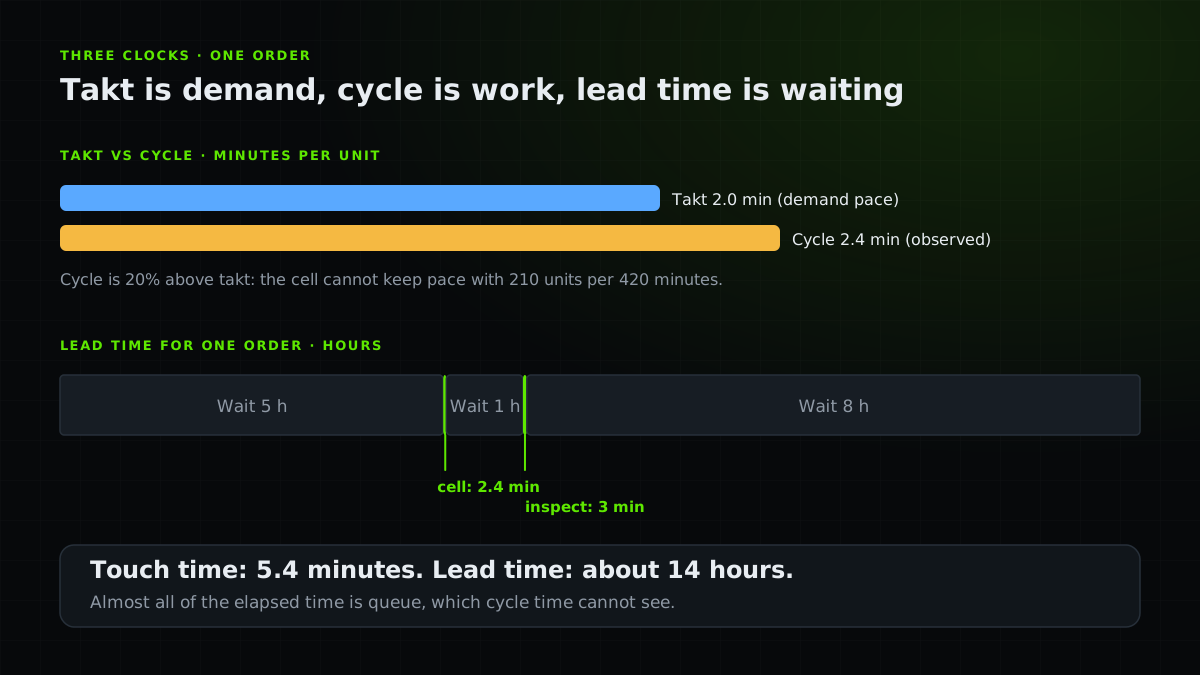
A cell has 420 minutes of available production time per shift and customer demand of 210 units per shift. Takt is 420 ÷ 210 = 2 minutes per unit.
The observed operator cycle is 2.4 minutes. That is 20% slower than takt, so the cell cannot sustainably meet demand with the current work design. But this says nothing about lead time. If an order waits 5 hours before the cell, 1 hour before inspection and 8 hours before shipping, the customer waits about 14 hours even though the order is touched for only 5.4 minutes.
| Clock | Question it answers | Example value |
|---|---|---|
| Takt time | How fast must we complete units to meet demand? | 2.0 min per unit |
| Cycle time | How long does the work take per unit? | 2.4 min per unit |
| Lead time | How long does an order take from start to finish? | About 14 hours |
Takt is demand, not machine speed
A common mistake is to treat takt as a target speed for every machine. Takt expresses the pace of customer demand. The production system has to be designed so the value stream can meet that pace reliably, which means allowing for workload, variation, maintenance, changeover, quality, material and staffing.
Takt also moves. If demand doubles, takt halves, and a process that was comfortable becomes the constraint. Recalculate it whenever demand or available time changes.
Cycle time has more than one meaning
Be explicit about which cycle you are measuring. Machine cycle, operator cycle, effective machine cycle, station cycle and process cycle can differ by minutes. Do not mix a machine’s automatic time with the total station cycle and then use it for staffing.
For staffing and line design, use the line balancing approach: compare each station’s total work content with takt, not the machine speed alone.
- Machine cycle: how long the equipment takes to complete its automatic cycle.
- Operator cycle: how long the person needs, including loading, unloading and walking.
- Station cycle: the larger of the two, or their combination if they cannot overlap.
- Process cycle: the elapsed time for a unit to pass through all steps.
Lead time is where queues hide
A process can have fast cycle times and terrible lead time because most of the elapsed time is waiting, not processing. That is why value-stream mapping separates process time from total lead time, and why lean manufacturing targets queues before touch time.
Lead time also depends on scheduling and release rules. Releasing more work than the constraint can process lengthens every queue. See production scheduling optimization for how release rules shape it.
When cycle time is below takt but output still misses demand
Look beyond the average cycle. A mean cycle below takt is not proof that the system has enough effective capacity. The causes are usually losses the average hides.
- Downtime
Stops reduce the time the cell can produce at all.
- Changeover
Time spent changing over is not spent at the cycle rate. See SMED changeover reduction.
- Starvation and blocking
The cell waits for material or for space downstream.
- Quality loss
Rejected units consume cycle time without counting toward demand.
- Mix and staffing
Some products take longer, and staffing gaps stretch the cycle.
Practical checklist
- Use net available time for takt, excluding breaks and planned stops.
- Use demand for the same period as the time you divide by.
- Recalculate takt when demand or available time changes.
- State which cycle you are measuring: machine, operator, station or process.
- Compare station work content with takt before setting staffing.
- Measure lead time across the whole value stream, including queues.
- Look for downtime, changeover, starvation and quality loss when cycle is below takt but output is short.
- Never treat takt as a target speed for a single machine.
FAQ
Questions before you join
Sources and further reading
Authoritative references used to research and verify this guide.