
A standardized-work combination table places manual work, walking and automatic machine time on a shared timeline. It shows which activities overlap and whether one operator can repeat the sequence safely. Simply adding all recorded times can badly overstate the circuit. This fictional example follows two parallel machines across two cycles, checks the next loading time and separates circuit time from average output spacing and customer takt.
Separate occupied operator time from unattended machine time.
Test the next circuit rather than drawing one convenient cycle.
Compare a realistic sequence with demand without promising output.
Observe the work before filling in the form
Record the work sequence, task boundaries, walking, waiting, machine start and finish, and normal variation. The Lean Enterprise Institute describes standardized work through takt, sequence and standard in-process stock. The combination table makes operator-machine relationships visible; it does not replace safe work instructions.
Use actual observations for a real decision, including changeovers and recurring checks. A machine cycle may overlap another task only when guards, interlocks and the required attention allow genuinely unattended operation. Never schedule two simultaneous manual tasks for one person.
A fictional circuit with two parallel machines
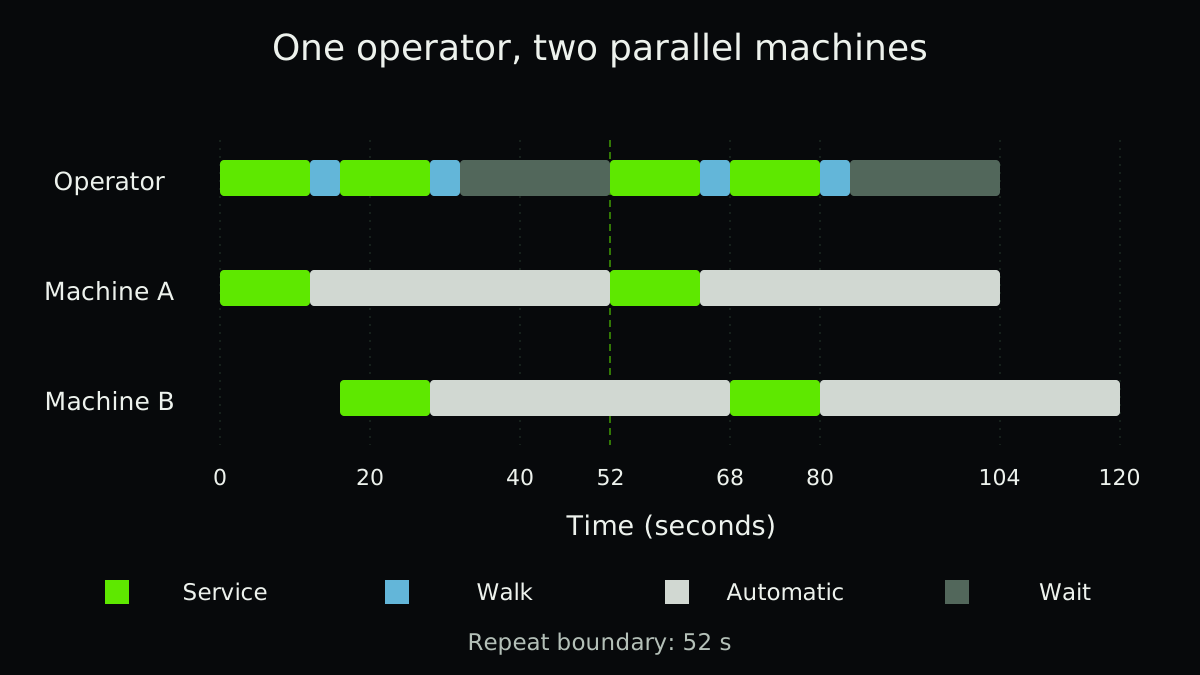
Machines A and B independently make the same finished part. Each needs 12 seconds of unload/load service, then runs automatically for 40 seconds. The walk between them takes four seconds. Parts, tooling and safe access are available. These are teaching assumptions, not measured factory data.
Service A from 0 to 12, walk to B from 12 to 16, service B from 16 to 28 and return from 28 to 32. A finishes at 52, so the operator waits 20 seconds before starting its next service. B runs from 28 to 68, across the circuit boundary.
| Activity | First interval, seconds | Operator needed? |
|---|---|---|
| Service A | 0-12 | Yes |
| Automatic A | 12-52 | No, under the safety assumption |
| Walk to B | 12-16 | Yes |
| Service B | 16-28 | Yes |
| Automatic B | 28-68 | No, under the safety assumption |
| Return to A | 28-32 | Yes |
| Wait at A | 32-52 | Available, but no extra task assumed |
Check that the second circuit actually fits
Repeat at 52 seconds. A service is now 52-64; B service is 68-80. B’s previous automatic run ends at 68, exactly when its next service starts. No operator intervals overlap, and neither machine is reloaded before its previous run finishes.
Adding 12 + 40 + 4 + 12 + 40 + 4 gives 112 seconds, but counts automatic time as if the operator stood idle beside each machine. The tested circuit is 52 seconds with 24 seconds of manual service, eight seconds of walking and 20 seconds waiting. The diagram includes the second circuit so that the cross-boundary machine run stays visible.
The 40-second automatic runs overlap other work. A feasible circuit must satisfy both the operator sequence and each machine’s next-ready time.
Two units per circuit is not one unit every 26 seconds
After the pipeline is running, completions occur at A52, B68, A104 and B120. That is two units per 52-second circuit, or 26 seconds per unit on average. Actual gaps alternate between 16 and 36 seconds. This result applies to two parallel machines, not two serial operations on the same part.
At a customer takt of 30 seconds per unit the ideal average rate is sufficient. Startup, scrap, stops, breaks and downstream batch constraints still matter. Use the three clocks guide to keep demand pace separate from observed cycle and lead time. Do not call the mean a delivery guarantee.
Change one assumption and redraw the sequence
If each walk takes 16 seconds, occupied time becomes 24 + 32 = 56 seconds. The operator becomes the repeat constraint; A is ready at 52 but receives service at 56. A shorter automatic cycle alone would not remove this walking constraint.
Before assigning more work to the 20-second wait in the original circuit, include the extra task’s travel, frequency, variation and safe interruption point. A mean that fits exactly may still be fragile. Test it with the person doing the job and use line balancing for the wider allocation.
- Capture a repeatable baseline
Observe several representative cycles and identify abnormal work separately.
- Draw resource rows
Put each operator and machine on its own row with start and finish times.
- Carry automatic runs forward
Show any run crossing the repeat boundary and check the next service.
- Trial a safe change
Record the actual result, variation and quality before revising the standard.
Keep a sequence people can use
The JSON resource includes the fictional timing and blank observation fields. Its labels are editable; it is not an approved work instruction. Include product, revision, operator involvement, safety checks and required in-process stock when adapting it.
Use SMED for setup work that changes the available pattern. Review the standard when product, layout or staffing changes. Vrolen is in private pilot; its connection is to retain a proposed change and the observed result rather than treating a polished chart as proof.
A related example from Abolfazl
Compare a single packing station with this parallel-machine circuit.
In English, on founder Abolfazl’s personal blog. This is related reading, not an independent technical source.
Practical checklist
- Identify parallel versus serial flow.
- Define the task and observation boundaries.
- Separate manual, walking, waiting and automatic intervals.
- Verify safe unattended operation.
- Check operator overlap across multiple circuits.
- Check each machine is ready for its next service.
- Distinguish circuit time, output spacing and takt.
- Retain variation, stock, revision and actual trial results.
FAQ
FAQ
Sources and further reading
Authoritative references used to research and verify this guide.