

Prioritize a spare part by what happens when it is unavailable, how quickly a suitable replacement can arrive and whether an approved alternative can restore the function. Purchase price and annual usage alone cannot answer that question. Keep criticality separate from the quantity to stock, which also needs demand, lead-time uncertainty and obsolescence evidence. This fictional three-part comparison shows a practical stock decision without inventing failure probabilities or promising a universal inventory formula.
Separate operational criticality from annual purchase spend.
Check the real restoration route and replenishment delay.
Record a stock decision with assumptions and an owner.
Identify the function that the missing part prevents
Begin with equipment, failure mode, exact compatible part and restoration requirement. A material number that groups incompatible revisions can create false availability. Verify manufacturer and engineering requirements before treating an alternative as interchangeable.
IBM’s spare-parts guidance distinguishes consumption-value classification from criticality-based review. An ABC spend class may help purchasing manage value, while a separate consequence-and-recovery review helps maintenance understand a shortage. Use each for its own question.
Compare parts under a stated operating context
All three entries below are fictional. The bearing stops a non-redundant conveyor and has an 18-week supplier lead time. The display is expensive but has an approved operational fallback; that fallback is an explicit teaching assumption, not a bypass recommendation.
The filter is consumed frequently and has short replenishment lead time. Its routine demand makes it a different stocking problem from a rarely used insurance spare. A safe alternative and a promised lead time need evidence, not a salesperson’s informal assurance.
| Part | Purchase price | Recovery context | Planning question |
|---|---|---|---|
| Conveyor bearing | EUR 80 | No approved substitute;18-week replenishment | Is a protected spare justified by consequence and delay? |
| Operator display | EUR 2400 | Approved fallback;2-day replacement | Does the fallback cover the actual operating period? |
| Service filter | EUR 12 | Recurring use;3-day replacement | What reorder rule fits actual consumption and lead time? |
Use consequence calculations without inventing risk
Suppose a missing bearing causes 12 hours of production loss and the separately justified lost contribution is EUR 400 per hour. The conditional consequence is EUR 4800, before any other distinct costs. This makes the shortage worth examining; it does not establish the expected annual benefit of buying a spare.
Expected-value analysis also needs a defensible probability and time horizon, plus holding, degradation, obsolescence and recovery costs. Do not assume one failure per year to make an 80-euro spare appear to have a proven return. Safety and environmental consequences may require a decision that money alone cannot settle.
This is the loss if the stated shortage occurs. No failure probability, annual saving or recommended stock quantity is inferred.
Choose a stock or no-stock rule with the recovery plan
Possible responses include a local protected spare, a verified shared pool, a supplier agreement, a qualified substitute or an approved no-stock decision. Assess whether each route actually meets the restoration need under plausible disruption.
For recurring consumables, use demand and replenishment data. For rare critical parts, historical zero use is not proof that stock has no value. Keep the basis visible and revisit it when equipment, supplier or operating context changes.
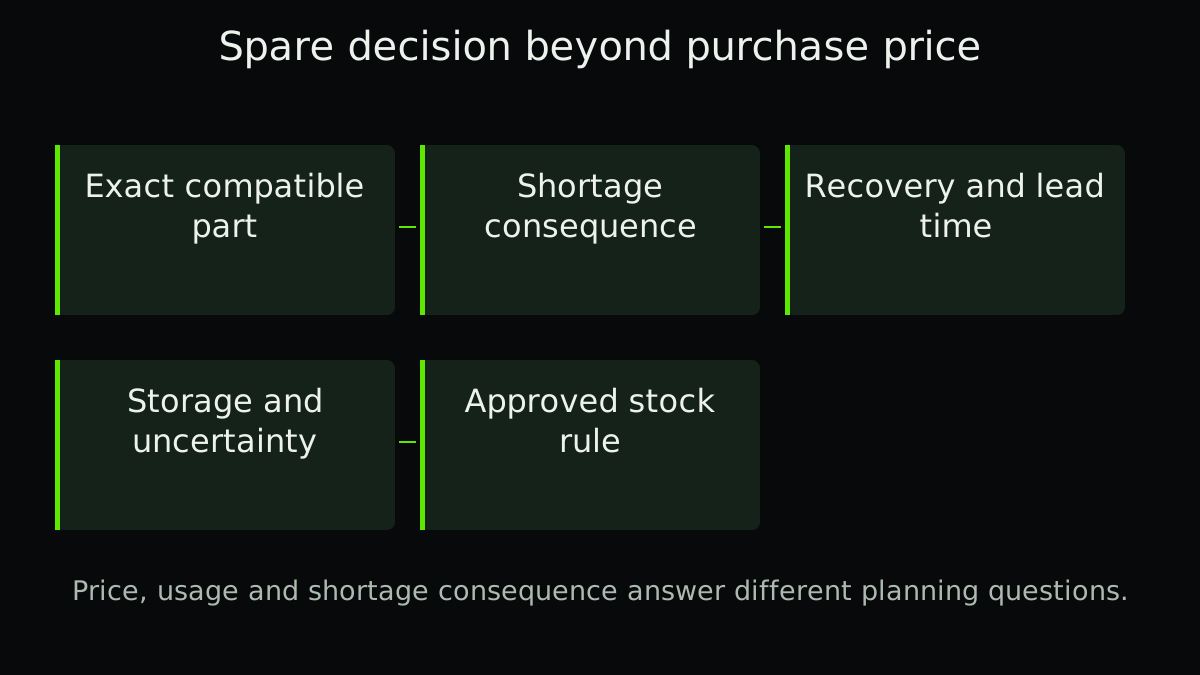
- Verify identity and compatibility
Link the part to equipment, revision, condition and approved alternatives.
- Review shortage consequences
State the lost function, safety implications and restoration requirement.
- Test recovery routes
Check actual lead-time evidence, storage life and access to each alternative.
- Approve and audit the rule
Record stock decision, quantity rationale, owner and review triggers.
Connect the storeroom with the maintenance job
A ready job needs the correct part, tool, skill and access together. Link the spare decision with maintenance backlog readiness instead of reporting inventory and planning as unrelated percentages.
Use RCM for the failure-management decision and downtime cost for a carefully bounded consequence estimate. A part’s price should not substitute for either analysis.
Keep a short decision record that can be challenged
Retain the reason for the decision, the evidence date and what would change it. Audit exact on-hand identity and storage condition. A criticality code with no underlying scenario is difficult to review when a supplier or machine changes.
The download includes the three fictional parts and a blank review record. Pick one long-lead item and verify its compatible revision, usable stock and recovery route before changing the stocking decision.
A related example from Abolfazl
Use a recurring conveyor fault to separate restoration from prevention.
In English, on founder Abolfazl’s personal blog. This is related reading, not an independent technical source.
Practical checklist
- Verify exact part and equipment identity.
- Record the failure mode and lost function.
- Check approved substitution and redundancy.
- Use evidenced lead-time and access assumptions.
- Separate criticality from spend classification.
- Avoid invented failure frequencies.
- Check storage condition and usable stock.
- Approve quantity rationale and review triggers.
FAQ
FAQ
Sources and further reading
Authoritative references used to research and verify this guide.