
First-pass yield is the share of units that meet requirements on their first trip through a defined process, without repair or another attempt. Divide those first-pass good units by the unique units entering that process. Keep repaired units out of the numerator even when they later ship. Final yield answers a different question: how many units eventually became acceptable. Report both alongside rework and scrap, using the same cohort and boundary, so a good shipment figure does not hide extra work.
Keep first-pass and final yield in separate measures.
Follow reworked parts without inventing extra units.
Connect the yield gap to workload and OEE quality.
Define what counts as a first pass
Choose the process and its acceptance rule before calculating yield. A part accepted without another attempt counts as first-pass good. A part repaired and accepted later belongs in final accepted output, but it cannot regain first-pass status.
ASQ’s glossary includes repair and repeat attempts in the exclusions from first-pass yield. Follow your documented test sequence: two planned checks can belong to one normal pass, while a repeat caused by failure is a different event. State the rule so shifts do not quietly use different definitions.
For the broader measurement context, see OEE loss analysis.
Give each physical unit one entry record
Use a serial number, lot position or another traceable unit identity. A rework visit is a new event on an existing unit. Counting it as a second incoming unit changes the denominator and hides how often original units fail.
Use a completed cohort where possible. If some units are awaiting disposition, show that pending count and avoid reporting final yield as though every outcome were known. For a period-based dashboard, label the period and how opening and closing WIP are treated.
Same cohort, process boundary and acceptance rule. Repaired units remain excluded from first-pass good output.
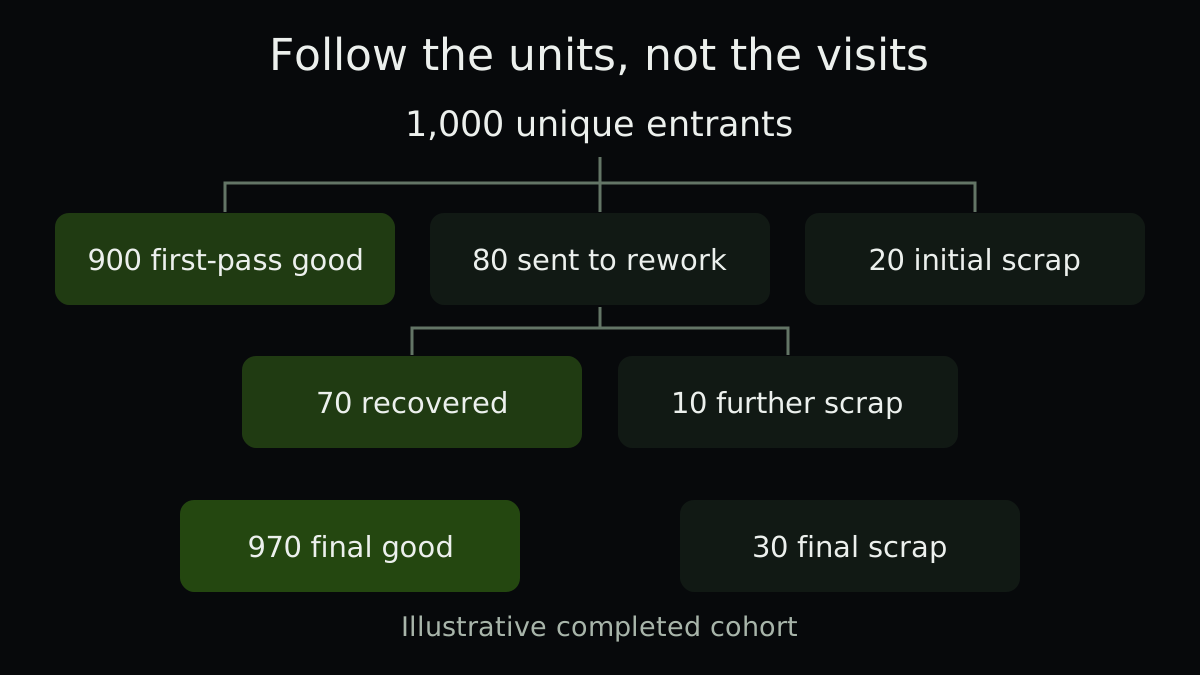
Follow 1,000 units all the way through
Illustrative completed cohort: 1,000 unique units enter inspection. 900 pass first time, 80 need repair and 20 are immediately scrapped. Every repaired unit gets one further attempt: 70 pass and 10 are scrapped.
The ledger balances: 900 + 70 + 30 = 1,000. Final accepted output is 970, but only 900 met requirements first time. This example is invented for teaching; it is not a reported plant result.
| Measure | Calculation | Result |
|---|---|---|
| First-pass yield | 900 ÷ 1,000 × 100% | 90% |
| Final yield | (900 + 70) ÷ 1,000 × 100% | 97% |
| Units needing rework | 80 ÷ 1,000 × 100% | 8% |
| Final scrap | (20 + 10) ÷ 1,000 × 100% | 3% |
Final yield can improve while the workload grows
The seven percentage-point gap between 90% and 97% reflects units rescued by repair in this example. It says nothing by itself about repair minutes, cost or the effect on other orders. Add those observations before choosing a response.
Suppose each of the 80 repairs takes three minutes: that is 240 minutes, or four hours of repair work. This is another illustrative assumption. It becomes lost production capacity only if that work competes for a resource that limits output; do not automatically call all four hours lost shipments.
- Keep a unit-outcome ledger
Record entry, first acceptance, rework route, final acceptance and scrap. Keep pending units visible.
- Calculate the two yields
Use unique entrants as the denominator. State the process and cohort on both measures.
- Measure the repair burden
Record repair and retest time, material and resource use, rather than inferring cost from the yield gap.
- Investigate the first failure
Segment by defect, product, process conditions and shift. Confirm the cause before changing settings.
Keep repaired output out of first-pass OEE quality
OEE, overall equipment effectiveness, combines availability, performance and quality. Vorne’s calculation guidance uses first-time good output for quality. For the same 1,000-unit first-pass boundary in our example, quality is 90%, not 97%.
The treatment of a second production pass requires an explicit counting convention. Vorne’s FAQ discusses practical rework cases. Keep rework time and repeat cycles consistent across the factors so the loss neither disappears nor gets charged twice. Do not transplant a final shipment yield into machine OEE.
Compare processes only after checking the definitions
A test station’s first-pass yield and a whole-line first-pass yield have different boundaries. For a sequential two-stage process, rolled throughput yield tracks the share passing every stage first time. With conditional stage yields of 90% and 95% on a matched flow, their product is 85.5%.
That calculation needs the relevant first-pass population at each stage. Averaging two yields, or multiplying unrelated shift percentages, does not reconstruct the journey of one cohort.
Use lean and Six Sigma to choose an improvement method and predictive quality to examine earlier warning signals. Keep release criteria and safety controls unchanged unless the authorized quality process approves a change.
Practical checklist
- Write the process boundary and acceptance rule.
- Track unique incoming units, not inspection visits.
- Identify repeats caused by failure.
- Exclude repaired output from first-pass good counts.
- Keep pending outcomes visible.
- Reconcile final accepted units plus scrap to entrants.
- Measure rework time and resource use separately.
- Confirm the OEE and stage-yield counting conventions.
FAQ
FAQ
Sources and further reading
Authoritative references used to research and verify this guide.