
Failure Mode and Effects Analysis (FMEA) helps a team identify how a product or process could fail, what would happen and which controls or changes deserve attention. A process FMEA connects each failure mode to its effects, possible causes and current prevention or detection controls. Use it before a change and keep it current afterward. This guide follows a fictional connector assembly from a risk entry to a proposed test, without inventing scores or claiming that an untested action works.
Write a failure mode that an operator can recognize.
Separate preventing an error from detecting its result.
Keep an action open until its evidence supports closure.
Start with one function and one boundary
For a process FMEA (PFMEA), define the operation being reviewed and its required output. A design FMEA examines the product design instead. ASQ describes the method as a team review; involve people who know the work, inspection and downstream use.
Our fictional operation inserts a connector into a housing before fastening. Its function is to seat the connector in the specified orientation without damaging the contacts. The review covers loading, fastening and release to the next operation. It does not assess every electrical or safety risk of the finished product.
If a failure has already occurred, use root cause analysis to investigate what happened. Feed confirmed findings back into the prospective risk review. An FMEA entry is not proof that its proposed cause is real.
Keep mode, effect and cause separate
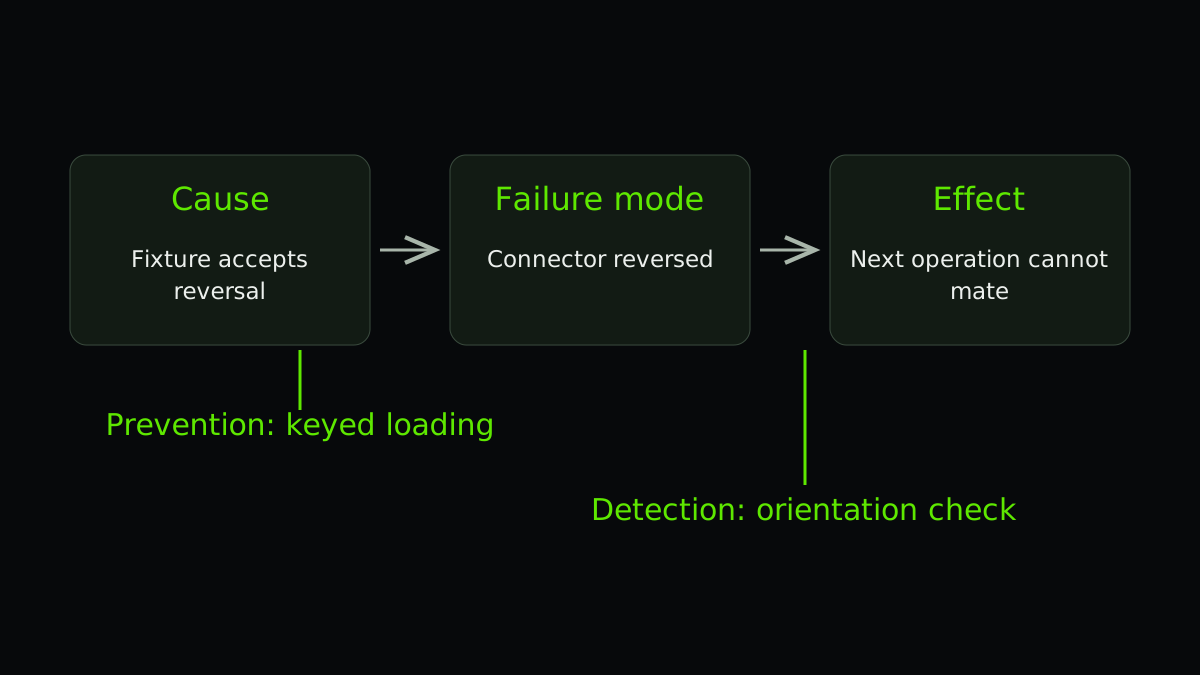
Write one chain that can be checked at the workstation. “Poor quality” cannot tell the team what to test. In the teaching example, the mode is a connector fastened in reverse, the effect is a housing that cannot mate at the next operation, and one possible cause is a symmetric loading fixture.
A visual check after fastening is a detection control. A fixture that cannot accept the reversed orientation addresses the loading opportunity. AIAG distinguishes prevention controls from detection controls. Neither should receive credit merely because it appears on a drawing.
| Entry | Fictional assembly record |
|---|---|
| Function | Seat the connector in its specified orientation. |
| Failure mode | Connector fastened in reverse. |
| Effect | Housing cannot mate at the next operation; rework required. |
| Possible cause | Fixture accepts both orientations. |
| Current control | Visual orientation check after fastening. |
| Proposed change | Keyed fixture; retain inspection while validating. |
Prioritize with the method that applies
Severity concerns the effect, occurrence concerns the cause or failure opportunity, and detection concerns the controls that could find it. Use your applicable scoring definitions and customer requirements. Missing evidence should remain an open question, not a conveniently low rating.
Some methods multiply severity, occurrence and detection ratings into a risk priority number: RPN = S × O × D. These ratings are not calibrated probabilities, and the product is not an expected financial loss. AIAG’s 2019 handbook announcement states that its harmonized AIAG/VDA method introduced Action Priority in place of RPN. That is not a new 2026 development.
Do not copy a universal “RPN below 100 is acceptable” rule or invent an Action Priority lookup. Use the applicable handbook, current errata and customer requirements. This example deliberately has no numeric ratings and makes no automotive-compliance claim. Serious effects still need competent review.
S: severity; O: occurrence; D: detection rating under the stated scale. The result is a ranking aid, not a probability or universal acceptance limit.
Write the action and its test before closing it
The proposed action is a keyed nest that prevents reverse seating before fastening. The process engineer owns the change; quality owns the independent check. Record a real due date, fixture revision and test protocol before work starts. Our proposed trial has not been run.
On an offline, safe test setup, challenge the fixture with the reversed orientation, each approved part variant and relevant tolerance extremes. Try restart and changeover conditions. Confirm that correctly oriented parts still seat without damage, then define what happens if the key is worn, missing or bypassed. Do not seed defects into customer-bound production.
| Review point | Evidence or status |
|---|---|
| Before | Symmetric fixture is a possible cause; verify it. |
| Proposed | Keyed nest plus written challenge protocol. |
| Implementation | Record actual revision, owner and completion date. |
| Effectiveness | Attach observed results; presently not tested. |
| After-action rating | Pending evidence and the applicable rating rules. |
- Confirm the failure path
Observe the loading opportunity safely and retain the evidence.
- Define success and failure
State which reversed cases must be blocked, which good variants must seat, and how failures stop release.
- Run and record the approved challenge
Keep part IDs, setup, fixture revision, each outcome and unexpected effects. Test quantity depends on risk and the approved plan.
- Review normal work
Check changeovers, wear and bypass opportunities. Reopen the action when evidence contradicts the claimed control.
A better detector does not remove the cause
A camera may find the reversed connector after fastening. That can reduce escapes while leaving the assembly error and rework in place. Check the camera against known good and known bad parts, including lighting and product changes. A high average accuracy can hide the failure mode that matters.
Adding inspection alone does not make the failure effect less severe. Review occurrence or detection ratings only when the corresponding evidence and method justify it. A different design may change the effect itself; a clearer inspection photo usually does not.
Use first-pass yield to observe rework, but do not attribute a later yield change to this fixture without comparable production conditions. If you add a model-based detector, the predictive quality guide covers separate validation needs.
Keep the record connected to the line
Transfer the verified control into the control plan, work instruction and maintenance checks. Name the response when it fails. “Check fixture” is too vague: identify the feature, method, frequency, owner and reaction.
The blank JSON template below can be copied for one failure chain. Open it in a text editor or import it into a data tool. It is an action record, not a complete customer-approved FMEA form. Keep a versioned copy with your actual scoring method and supporting evidence.
Vrolen is in private pilot. Its improvement focus makes the connection practical: retain what changed, why it was chosen and what happened afterward. Do not let an approval signature stand in for a tested result.
A related example from Abolfazl
Read a different fulfilment example, keeping its rating method separate from yours.
In English, on founder Abolfazl’s personal blog. This is related reading, not an independent technical source.
Practical checklist
- Define the operation and required function.
- Name the failure mode separately from its effect.
- Verify possible causes rather than copying labels.
- Separate existing controls from proposed changes.
- Use the applicable rating and priority method.
- Assign an owner, due date and evidence requirement.
- Record the actual test and unintended effects.
- Update the control plan and define a reopening trigger.
FAQ
FAQ
Sources and further reading
Authoritative references used to research and verify this guide.