
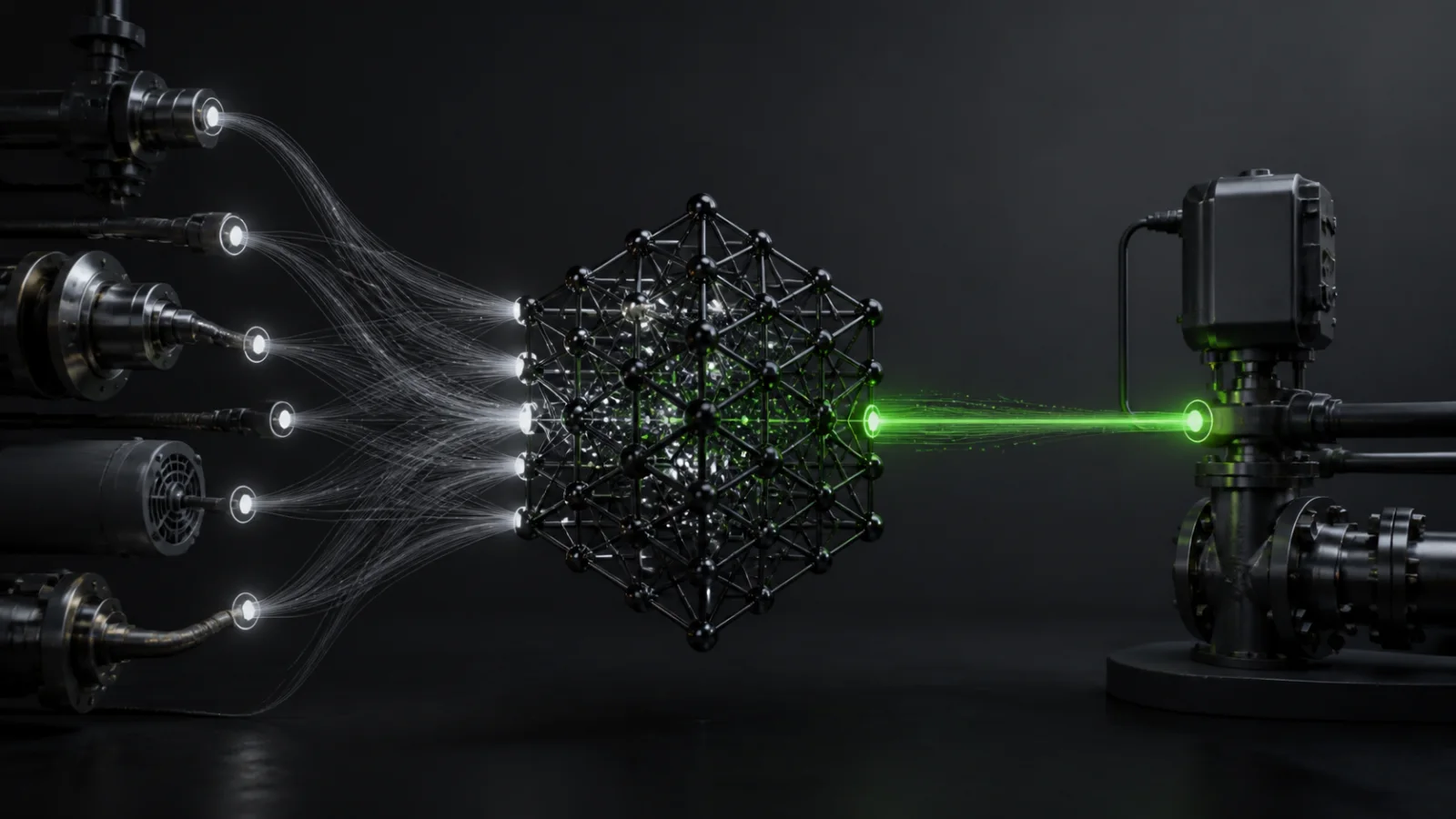
Connect production data, domain knowledge, machine learning, and simulation with clear confidence and human control. Choose a bounded decision, establish a non-AI baseline, prepare traceable data, evaluate models across operating regimes, expose confidence and explanations, and connect recommendations to a human-owned workflow. A high offline score does not prove operational value. Data leakage, rare regimes, changing equipment, automation bias, and unsafe actions require ongoing validation and control. Industrial AI in manufacturing: AI and automation may accelerate analysis, but people remain responsible for safety, quality, interpretation, and approval.
Earlier operational signals
Scalable pattern detection
Human-controlled recommendations
Start with a bounded industrial decision
Connect production data, domain knowledge, machine learning, and simulation with clear confidence and human control.
A high offline score does not prove operational value. Data leakage, rare regimes, changing equipment, automation bias, and unsafe actions require ongoing validation and control. Industrial AI in manufacturing: Use evidence from the real process and keep source, timestamp, unit, and uncertainty visible.
- decision and cost of error
- representative production data
- domain constraints
- validation and drift measures
Build representative, traceable production evidence
Industrial AI in manufacturing: Use evidence from the real process and keep source, timestamp, unit, and uncertainty visible. Focus on decision and cost of error, representative production data, domain constraints, validation and drift measures.
Choose a bounded decision, establish a non-AI baseline, prepare traceable data, evaluate models across operating regimes, expose confidence and explanations, and connect recommendations to a human-owned workflow. Industrial AI in manufacturing: Preserve a baseline and change one important assumption at a time so the team can explain the result.
- decision and cost of error
- representative production data
- domain constraints
- validation and drift measures
Evaluate the model across operating regimes
Choose a bounded decision, establish a non-AI baseline, prepare traceable data, evaluate models across operating regimes, expose confidence and explanations, and connect recommendations to a human-owned workflow.
A high offline score does not prove operational value. Data leakage, rare regimes, changing equipment, automation bias, and unsafe actions require ongoing validation and control. Industrial AI in manufacturing: Preserve a baseline and change one important assumption at a time so the team can explain the result.
Design confidence, escalation, and safe fallback
Industrial AI in manufacturing: Use simulation or a controlled pilot when interactions, queues, failures, mix, or timing could move the effect elsewhere. Choose a bounded decision, establish a non-AI baseline, prepare traceable data, evaluate models across operating regimes, expose confidence and explanations, and connect recommendations to a human-owned workflow.
A high offline score does not prove operational value. Data leakage, rare regimes, changing equipment, automation bias, and unsafe actions require ongoing validation and control.
- Start with a bounded industrial decision
Connect production data, domain knowledge, machine learning, and simulation with clear confidence and human control.
- Build representative, traceable production evidence
Industrial AI in manufacturing: Use evidence from the real process and keep source, timestamp, unit, and uncertainty visible.
- Evaluate the model across operating regimes
Choose a bounded decision, establish a non-AI baseline, prepare traceable data, evaluate models across operating regimes, expose confidence and explanations, and connect recommendations to a human-owned workflow.
- Design confidence, escalation, and safe fallback
Industrial AI in manufacturing: Use simulation or a controlled pilot when interactions, queues, failures, mix, or timing could move the effect elsewhere.
- Monitor drift and operating value together
Industrial AI in manufacturing: Assign an owner, review date, response rule, and success measure. Compare the observed result with the prediction and update the standard.
Monitor drift and operating value together
Industrial AI in manufacturing: Assign an owner, review date, response rule, and success measure. Compare the observed result with the prediction and update the standard.
Industrial AI in manufacturing: AI and automation may accelerate analysis, but people remain responsible for safety, quality, interpretation, and approval. A high offline score does not prove operational value. Data leakage, rare regimes, changing equipment, automation bias, and unsafe actions require ongoing validation and control.
A related example from Abolfazl
Check what changes when the same AI pilot moves to a second plant.
In English, on founder Abolfazl’s personal blog. This is related reading, not an independent technical source.
Practical checklist
- Connect production data, domain knowledge, machine learning, and simulation with clear confidence and human control.
- Industrial AI in manufacturing: Use evidence from the real process and keep source, timestamp, unit, and uncertainty visible.
- Industrial AI in manufacturing: Preserve a baseline and change one important assumption at a time so the team can explain the result.
- Choose a bounded decision, establish a non-AI baseline, prepare traceable data, evaluate models across operating regimes, expose confidence and explanations, and connect recommendations to a human-owned workflow.
- Industrial AI in manufacturing: Use simulation or a controlled pilot when interactions, queues, failures, mix, or timing could move the effect elsewhere.
- Industrial AI in manufacturing: Assign an owner, review date, response rule, and success measure. Compare the observed result with the prediction and update the standard.
- Industrial AI in manufacturing: AI and automation may accelerate analysis, but people remain responsible for safety, quality, interpretation, and approval.
FAQ
FAQ
Sources and further reading
Authoritative references used to research and verify this guide.