
An agentic AI system works toward a goal across several steps: it observes a situation, gathers evidence, chooses the next analysis, calls other software and proposes or takes a bounded action. A copilot answers questions; an agent does work. In manufacturing the important word is bounded: decision rights, confidence thresholds, approval rules, fallback states and an audit trail. Start with decisions that need a lot of investigation and have limited consequences.
A clear line between copilots and agents
Three first use cases that are decision-heavy and low-consequence
A five-level autonomy ladder and a list of what must stay human
An AI agent is not a chatbot beside a dashboard
A manufacturing copilot helps a person query data, summarize information, draft an analysis or retrieve knowledge. An agent goes further. It operates toward a defined goal across multiple steps: it observes, gathers evidence, chooses the next analytical action, calls software or services, proposes or executes a bounded action and observes the result.
The important word in manufacturing is bounded. A useful plant agent is not “AI runs the factory.” It has decision rights, process boundaries, confidence thresholds, approval requirements, fallback states and an audit trail.
| Copilot | Agent | |
|---|---|---|
| Works by | Answering a person’s request | Pursuing a goal across steps |
| Typical output | A summary, a chart, a draft | An investigation, a ranked option set, a bounded action |
| Needs | Access to data | Access to data, tools, decision rights and guardrails |
| Main risk | A wrong answer that a person may catch | A wrong action taken inside a system |
| Control | The user reads and decides | Thresholds, approvals and audit |
Why the conversation is happening now
Deloitte’s 2026 manufacturing outlook lists agentic AI among the investments that can raise competitiveness and agility, and describes agentic systems that act across multiple systems “with a human in the loop for final approvals”. Deloitte’s AI in Manufacturing 2026 survey of more than 140 manufacturers found that 84% already generate measurable value from AI, while only around 20% of use cases are scaled.
That gap between pilot value and scaled value is the practical problem. It rarely comes from the model. It comes from data, governance and deployment, which is where agents will succeed or fail.
Good first use cases are decision-heavy and consequence-bounded
Choose work that costs people hours of investigation, where a wrong suggestion is caught by a person before it does damage.
- Downtime investigation agent: collects the stop timeline, machine states, recent maintenance, product and changeover context and similar past events, then proposes causal candidates. A human engineer validates the diagnosis and the countermeasure.
- Schedule-repair agent: detects a material or equipment disruption, evaluates feasible resequencing options, estimates service and changeover consequences and presents options to the planner.
- Continuous-improvement agent: detects a repeated loss pattern, drafts a problem statement, links the evidence, finds related past investigations and proposes a bounded experiment. See AI for continuous improvement.
An autonomy ladder
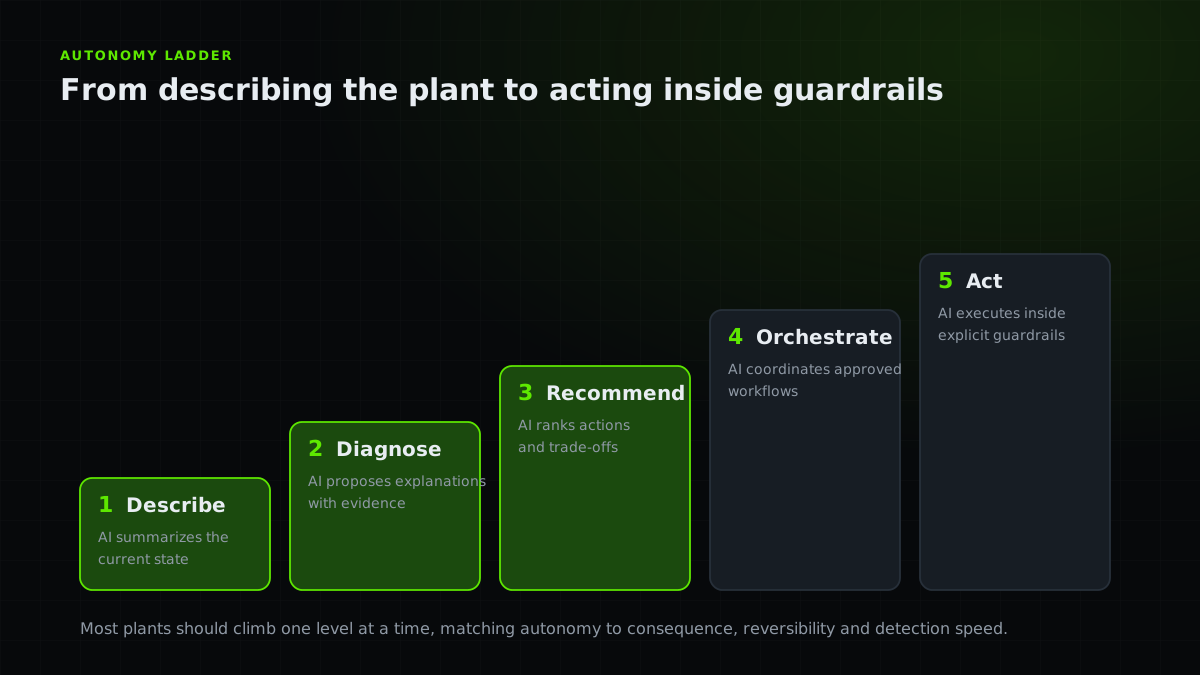
Autonomy is not on or off. Use five levels, and move up one at a time.
- Describe
AI summarizes the state of the plant.
- Diagnose
AI proposes explanations with the evidence behind them.
- Recommend
AI ranks actions and their trade-offs.
- Orchestrate
AI coordinates workflows that people have approved.
- Act
AI executes within explicit guardrails.
The hard part is not the model
Agents fail when tags have inconsistent meaning, timestamps do not line up, work orders cannot be linked to assets and events, reason codes are unreliable, standard work is not written down or decisions have no owner. Agentic operations need an operational context layer, not only a language model. See manufacturing data analytics for how to build one.
Keep human approval wherever an action affects safety, product conformity, regulatory controls, critical maintenance, customer commitments or high-value production changes. Match autonomy to the consequence, the reversibility, the confidence and how quickly a wrong action would be detected.
Measure an agent like an operating system, not a chatbot
Do not report conversations, tokens or suggestions generated. Report time to diagnosis, recommendation acceptance, false escalations, prevented or recovered loss, decision latency, intervention outcome and recurrence.
The opportunity is not “AI explains your dashboard.” It is an unbroken chain from evidence to reasoning, scenario, decision, controlled action and verified outcome. Read industrial AI in manufacturing for the wider picture on validation and drift.
Common mistakes when introducing agents
Most agent projects stall for organizational reasons, not technical ones.
- Starting with the model instead of the decision it will serve.
- Giving an agent write access before it has earned trust in a read-only role.
- Measuring activity, such as prompts and suggestions, instead of outcomes.
- Skipping the audit trail, so nobody can reconstruct why it acted.
- Assuming poor data quality is a problem the model will absorb.
Practical checklist
- Name the bounded decision the agent is for.
- Decide who owns that decision and what the agent may do alone.
- Write down thresholds, approvals and fallback states.
- Start at describe or diagnose, and move up one level at a time.
- Fix data meaning, time alignment and reason codes first.
- Keep human approval for safety, quality and customer commitments.
- Log every observation, action and result for audit.
- Measure diagnosis time, acceptance, recovered loss and recurrence.
FAQ
Questions before you join
Sources and further reading
Authoritative references used to research and verify this guide.