
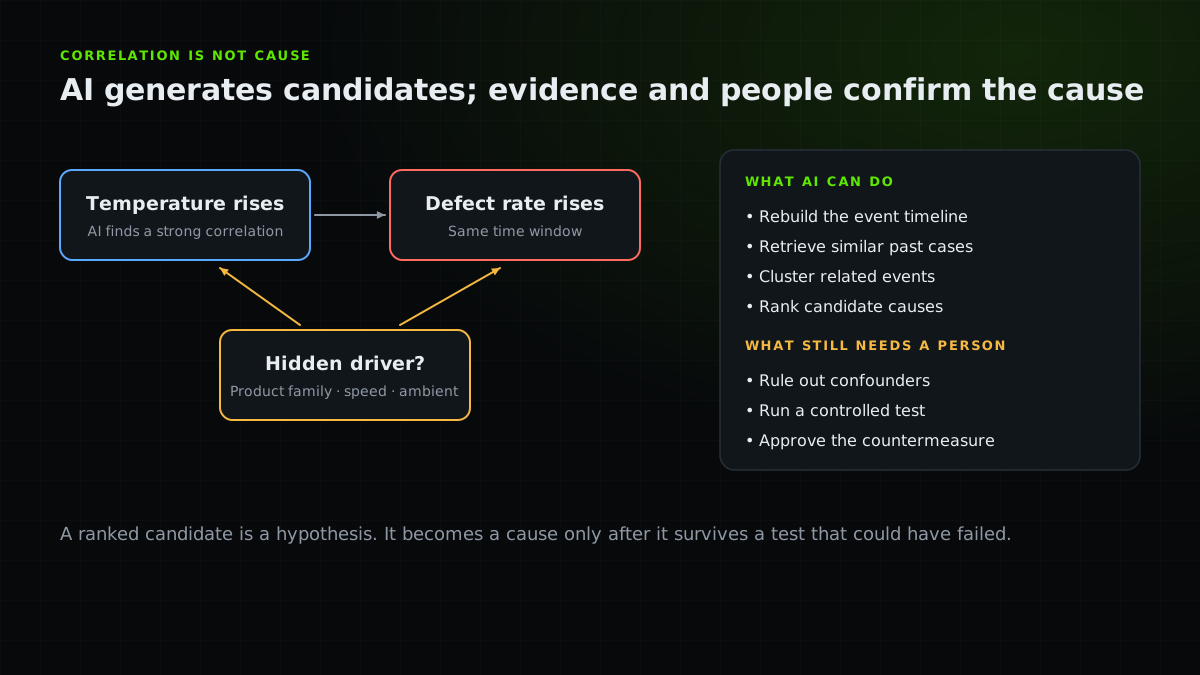
AI speeds up root-cause analysis by rebuilding event timelines, retrieving similar past cases, clustering related events and ranking candidate causes. It cannot prove a cause, because a strong correlation can come from a hidden third factor such as product family or speed. Treat every AI-ranked cause as a hypothesis, rule out confounders, test it with a controlled change, and have a person approve the countermeasure.
A split between what AI does well and what still needs people
Four ways AI misleads an investigation
A path from candidate cause to verified cause
Why manual RCA loses time
Most of the time in a root-cause investigation goes to assembling evidence, not thinking about it: pulling alarms, machine states, maintenance records, quality results and shift notes into one timeline. By the time the picture exists, the team may have moved on, or memory of the event has faded.
This is the part AI is well suited to. Reconstructing the timeline from several systems is tedious for a person and routine for software.
Where AI helps, and where a person is still needed
Divide the work by what is being asked. AI is strong at collecting and pattern-finding. People are needed where the question is whether a pattern is a cause.
| Task | AI | Person |
|---|---|---|
| Rebuild the event timeline | Strong | Reviews for gaps |
| Retrieve similar past cases | Strong | Judges relevance |
| Cluster related events | Strong | Names the pattern |
| Rank candidate causes | Useful | Decides what to test |
| Rule out confounders | Weak | Leads |
| Design a controlled test | Assists | Leads |
| Approve the countermeasure | No | Owns |
Candidate cause versus verified cause
A candidate cause is a hypothesis with some supporting data. A verified cause has survived a test that could have proved it wrong, and the fix has been shown to change the outcome. Confusing the two is the most common failure of automated RCA.
Software that jumps from an anomaly straight to “the cause” has skipped the tests. Ask what competing explanations were examined, what evidence would falsify the claim and how the result will be checked after the change. This is the same discipline as classic root-cause analysis, applied to a faster generator of hypotheses.
Four ways AI misleads an investigation
Each of these is well known in statistics, and each is easy to hit when data comes from many plant systems.
- Leakage
The model sees information created after the event, such as a rework code, and learns a shortcut.
- Confounding
A hidden factor drives both the suspected cause and the effect.
- Missing context
Key facts, such as an operator action or a material change, were never recorded.
- Common-cause signals
Many variables move together with the shift or the product, so all of them look important.
Close the loop
Once a cause is verified, feed the result into corrective action, standard work and the plant’s record of past cases. That record improves the next AI-assisted investigation, because similar-case retrieval is only as good as what was captured. Predictive quality, a downtime Pareto and manufacturing data analytics all depend on the same discipline of recording what was tested and what was found, and the agentic AI guide covers how far to let software carry the work.
Practical checklist
- Use AI to assemble the timeline and retrieve similar cases.
- Treat every AI-ranked cause as a hypothesis.
- Check for leakage from information created after the event.
- Look for hidden drivers such as product family, speed and ambient conditions.
- Note what was never recorded.
- Test the leading hypothesis with a change that could fail.
- Have a person approve the countermeasure.
- Record the tested causes and the result for future cases.
FAQ
Questions before you join
Sources and further reading
Authoritative references used to research and verify this guide.