
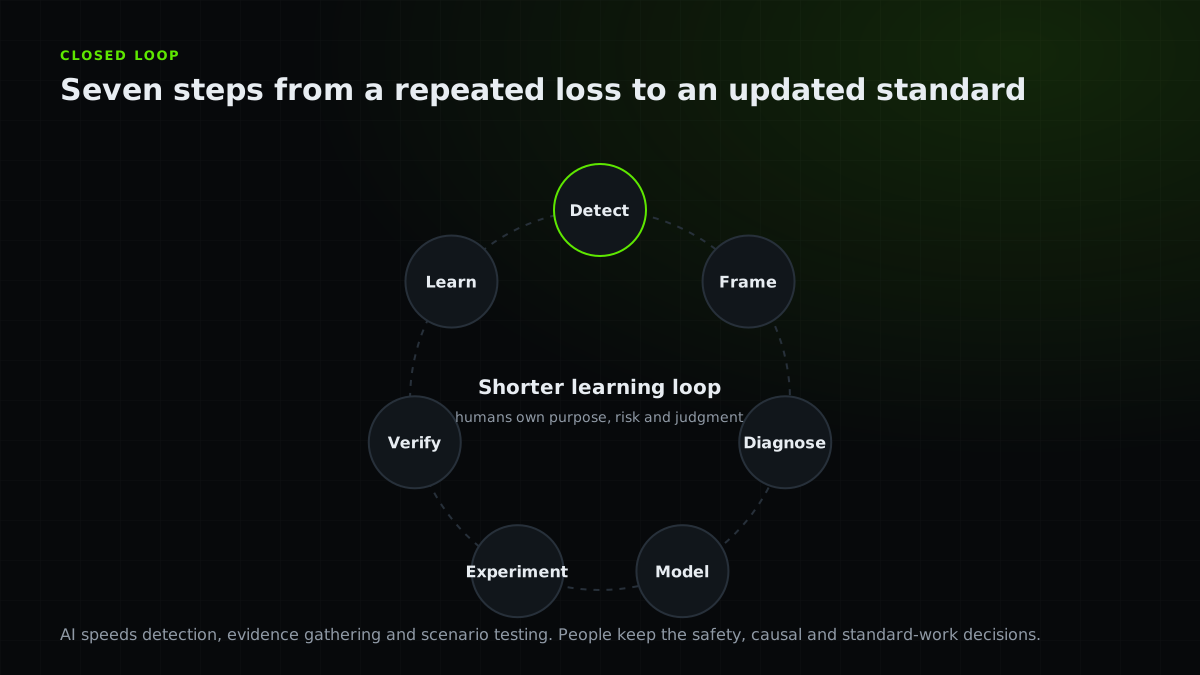
AI for continuous improvement means using AI to shorten the loop between a repeated loss and a verified change: detect the pattern, frame the gap, diagnose causes, model the trade-offs, design a small experiment, verify the result and update the standard. AI speeds the evidence and analysis steps. People still own purpose, risk, safety, causal judgment and acceptance of the countermeasure. AI does not replace Kaizen. It shortens the time between iterations.
A seven-step loop you can map to your current process
A clear split between what AI speeds up and what people own
Why most AI in manufacturing misses the improvement loop
Most AI in manufacturing skips the improvement loop
Most manufacturing AI is aimed at predictive maintenance, vision inspection and forecasting. Those matter, and each solves one bounded problem. Continuous improvement is a different job: it is the repeating system by which a plant finds, tests and standardizes better ways of working.
That system has a slow part. Detecting a repeated loss, assembling evidence, ranking causes and estimating trade-offs take people days or weeks. Shortening those steps is where AI belongs, and it is what makes the loop faster without removing anyone from it.
The closed loop, step by step
The loop has seven steps. AI helps most in the first four and in verification. The people who work the process own every decision.
| Step | What happens | Where AI helps |
|---|---|---|
| 1. Detect | A repeated loss, drift, bottleneck or quality change is noticed | Watching many signals continuously; flagging patterns |
| 2. Frame | The gap is stated with a boundary and an impact | Drafting a problem statement from evidence |
| 3. Diagnose | Causal candidates are generated and tested | Timelines, similar cases, ranked candidates. See AI root cause analysis |
| 4. Model | Propagation and trade-offs are estimated | Running scenarios; comparing options |
| 5. Experiment | The smallest safe test is designed and run | Suggesting test designs; people decide |
| 6. Verify | Prediction is compared with the actual result | Comparing before and after, watching recurrence |
| 7. Learn | Standards and knowledge are updated | Retrieving and linking the record for future cases |
What humans still own
Some parts of improvement are not analysis problems. They are judgment, accountability and trust, and they stay with people.
- Purpose: which customer or system problem is worth solving.
- Risk and safety: what is allowed to change and what is not.
- Causal judgment: whether a candidate cause is convincing.
- Acceptance of the countermeasure: who is accountable if it fails.
- Policy and standard-work changes: what the plant commits to doing differently.
Where an AI-assisted loop fails
The failure modes are familiar from any improvement effort, and AI amplifies them when the basics are missing. Inconsistent data makes the diagnosis step unreliable. A missing baseline makes verification impossible. Skipping the experiment and moving from a ranked cause to a rollout defeats the point of the loop.
Keep the discipline of PDCA: a prediction before the test and a comparison after. A Kaizen event can use AI-assembled evidence and still needs the people at the process to test the change. See also continuous improvement in manufacturing for the surrounding management system.
- Baseline
Record the current result before anything changes.
- Prediction
State what should happen and how you would know if you are wrong.
- Test
Run the smallest safe change.
- Check
Compare the result with the prediction, including side effects.
- Standardize
Update standard work only for what the evidence supports.
Why this is a category, not a feature
A plant that wants AI-native continuous improvement needs evidence, reasoning, scenario testing and verification in one connected record, not five tools that each hold a fragment. Deloitte’s 2026 survey of more than 140 manufacturers found that 84% report measurable AI value but only around 20% of use cases are scaled, which points to integration and governance as the limiting factor. The agentic AI guide covers how much autonomy each step can safely take.
Practical checklist
- Map your current improvement process to the seven steps.
- Find the slowest step and ask whether evidence gathering causes the delay.
- Use AI to assemble evidence and rank candidates, not to close the loop.
- Record a baseline before every change.
- State a prediction before every test.
- Keep people accountable for purpose, risk, cause and acceptance.
- Verify against the prediction over a representative window.
- Update the standard and the knowledge record after each cycle.
FAQ
Questions before you join
Sources and further reading
Authoritative references used to research and verify this guide.