
Calculate manufacturing downtime cost as contribution lost on sales you cannot recover, plus extra costs caused by the stop. Start with the affected orders, then check whether spare capacity can recover them. Include repair, restart scrap and any additional recovery expense once. Avoid multiplying stopped hours by revenue and calling the result a loss. The same one-hour stop can have very different costs depending on demand, buffers and the recovery plan.
Separate lost sales from production that can be recovered.
Calculate three recovery scenarios from the same inputs.
Keep fixed wages and overhead out of a short-run loss twice.
Start with the order that might be missed
A stopped machine gives you an event. To price it, follow the event through to a customer order: what output is missing, when is it due, and can the rest of the line catch up? A buffer may cover the interruption. A full schedule may leave no room to recover.
Choose a horizon, such as the next committed delivery. Production that is late but eventually sold can create overtime or penalties without losing the full sale. Production for which demand has disappeared has a different consequence. Keep those cases separate.
Use production downtime tracking to establish the stop duration and affected product. Machine minutes alone cannot tell you the financial result.
Use contribution for unrecoverable sales
Contribution per unit is selling price minus the variable costs avoided when that sale is not made. ACCA explains this distinction in its cost-volume-profit guidance. It is a short-run model with stated price, product-mix and cost assumptions, not a universal downtime tariff.
Add expenses that change because of the interruption. Regular wages and rent may continue anyway; listing them again beside lost contribution usually overstates the incremental loss. For a longer-term decision, ask finance which costs would actually change.
Lost contribution = unrecoverable sales units × contribution per unit. Extra costs are incremental and counted once.
One stop, three possible bills
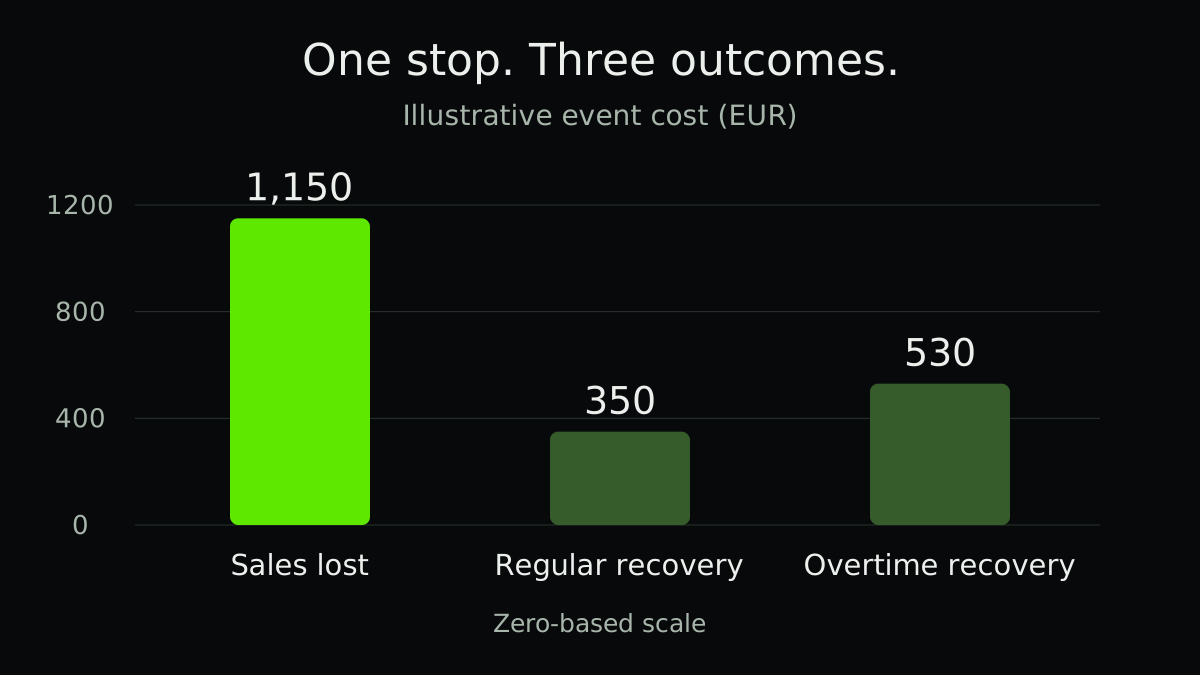
Illustrative example: one hour of stopped production would normally deliver 100 good units. Each unit sells for €20 and has €12 of avoidable variable cost, leaving €8 of contribution. Confirmed customer demand exists for all 100 units.
The stop causes €250 in parts and outside repair service, plus €100 of restart scrap. These amounts do not overlap with each other or with the avoided unit costs. The €180 overtime figure below is an additional recovery expense. All values are teaching assumptions, not a factory benchmark.
| Outcome before delivery | Lost contribution | Extra costs | Total |
|---|---|---|---|
| 100 sales cannot be recovered | 100 × €8 = €800 | €250 + €100 = €350 | €1,150 |
| All units recovered in regular capacity | €0 | €350 | €350 |
| All units recovered with extra overtime | €0 | €350 + €180 | €530 |
Build the estimate with production and finance
Use the demonstrated good-output rate for the affected product, rather than the fastest nameplate speed. Then test recovery against actual constraints: staffing, materials, changeovers and the delivery promise.
NIST’s manufacturing maintenance survey considers several kinds of loss associated with maintenance practice. Its aggregate findings do not give a cost per stopped hour for your plant. Keep your event calculation traceable to local records.
- Set the boundary
Identify the line, product, affected orders and delivery horizon. Avoid adding several machine stops that describe one line interruption.
- Test the recovery plan
Have the planner confirm which units can be recovered and where the capacity comes from.
- Price each consequence once
Have finance validate contribution, repair, scrap, overtime, freight and contractual charges.
- Replace estimates after the event
Compare the proposed recovery with shipments and actual spending. Keep unknown costs marked as unknown.
Small accounting choices can inflate the result
Do not charge the full value of a scrapped part and then charge the same material again as restart loss. ASQ’s cost-of-quality framework treats scrap and rework as internal failure costs; your ledger still needs to keep the amounts distinct.
Add a late-delivery penalty only when it applies. Record customer-retention risk separately unless you have a defensible estimate and horizon. A dramatic number with hidden assumptions makes prioritization harder.
Shared capacity also matters. Recovering one order may displace another. Include that displaced contribution or recovery cost once, rather than declaring recovery free.
Use the range to choose the next improvement
When recovery is uncertain, show a range with named scenarios. In our example €350 to €1,150 is more informative than a single cost-per-hour claim. Explain which schedule condition moves the result between those endpoints.
Compare repeated events on the same basis. Pair the estimate with frequency, confidence and the cost of prevention. Read predictive maintenance for the maintenance decision and the improvement portfolio guide for selecting work.
Never delay a required safety or quality action because a short-run financial estimate looks small. Approved site procedures remain the operating authority.
Practical checklist
- Name the affected orders and delivery horizon.
- Measure the good-output rate for this product.
- Confirm demand rather than assuming every unit would sell.
- Separate unrecoverable sales from delayed production.
- Have finance check the contribution per unit.
- List only additional event and recovery costs.
- Check for overlapping scrap, labor and capacity charges.
- Reconcile the estimate with shipments and actual expenses.
FAQ
FAQ
Sources and further reading
Authoritative references used to research and verify this guide.