
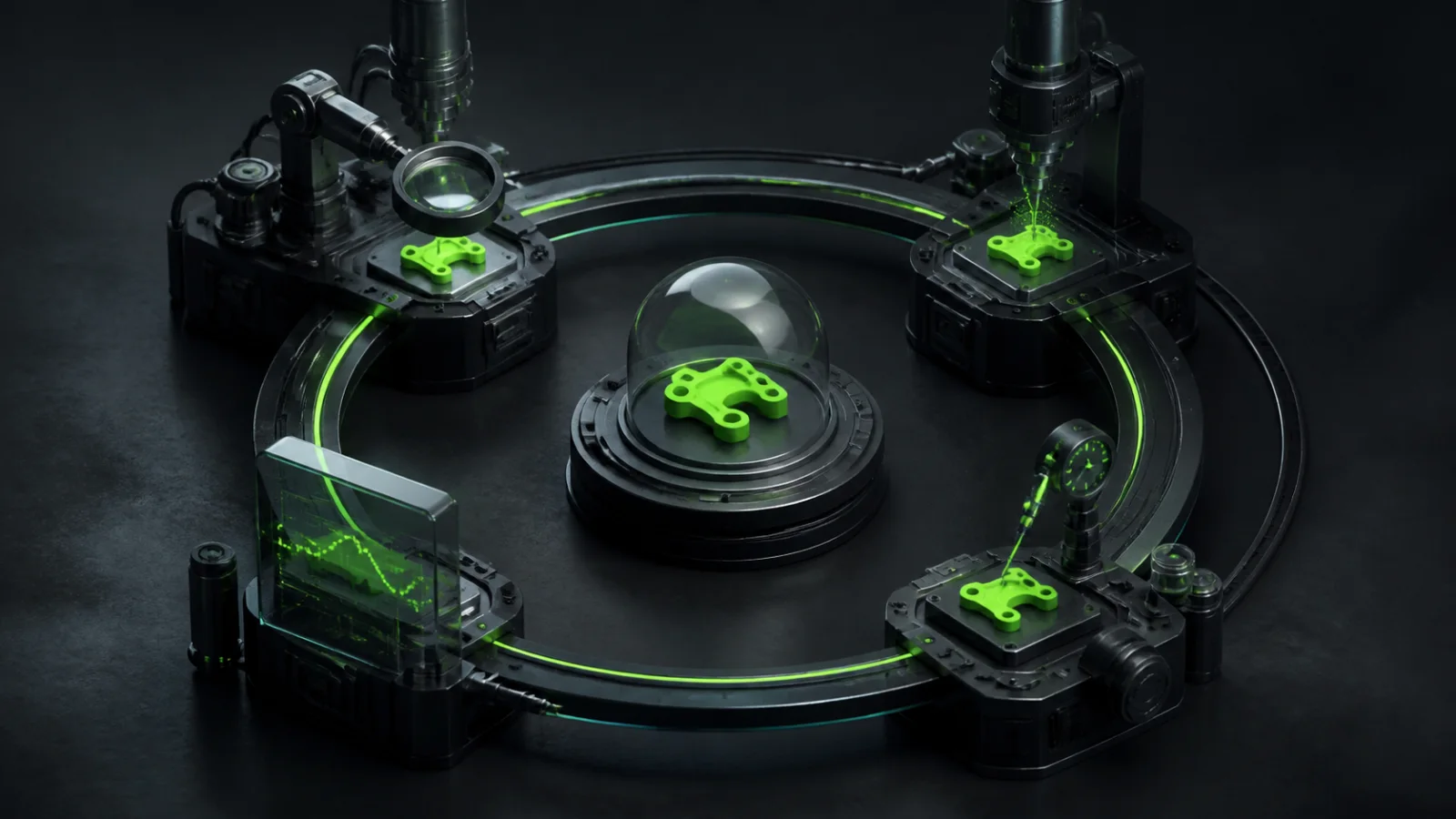
Define a prediction, test a controlled change, study the result, and standardize only what the evidence supports. Plan states the gap, causal reasoning, prediction, metric, and test. Do runs the smallest safe experiment. Check compares observed and predicted behavior. Act standardizes, adjusts, or abandons the change and starts the next cycle. A completed action plan is not a completed PDCA. Without a prediction and comparison, Check becomes reporting and Act becomes automatic rollout. PDCA cycle: AI and automation may accelerate analysis, but people remain responsible for safety, quality, interpretation, and approval.
Explicit predictions
Fast controlled learning
Evidence-based standards
Write a prediction that can be wrong
Define a prediction, test a controlled change, study the result, and standardize only what the evidence supports.
A completed action plan is not a completed PDCA. Without a prediction and comparison, Check becomes reporting and Act becomes automatic rollout. PDCA cycle: Use evidence from the real process and keep source, timestamp, unit, and uncertainty visible.
- baseline condition
- explicit prediction
- controlled test result
- standardization evidence
Build a baseline that matches the question
PDCA cycle: Use evidence from the real process and keep source, timestamp, unit, and uncertainty visible. Focus on baseline condition, explicit prediction, controlled test result, standardization evidence.
Plan states the gap, causal reasoning, prediction, metric, and test. Do runs the smallest safe experiment. Check compares observed and predicted behavior. Act standardizes, adjusts, or abandons the change and starts the next cycle. PDCA cycle: Preserve a baseline and change one important assumption at a time so the team can explain the result.
- baseline condition
- explicit prediction
- controlled test result
- standardization evidence
Run the smallest safe test
Plan states the gap, causal reasoning, prediction, metric, and test. Do runs the smallest safe experiment. Check compares observed and predicted behavior. Act standardizes, adjusts, or abandons the change and starts the next cycle.
A completed action plan is not a completed PDCA. Without a prediction and comparison, Check becomes reporting and Act becomes automatic rollout. PDCA cycle: Preserve a baseline and change one important assumption at a time so the team can explain the result.
Study the gap between prediction and result
PDCA cycle: Use simulation or a controlled pilot when interactions, queues, failures, mix, or timing could move the effect elsewhere. Plan states the gap, causal reasoning, prediction, metric, and test. Do runs the smallest safe experiment. Check compares observed and predicted behavior. Act standardizes, adjusts, or abandons the change and starts the next cycle.
A completed action plan is not a completed PDCA. Without a prediction and comparison, Check becomes reporting and Act becomes automatic rollout.
- Write a prediction that can be wrong
Define a prediction, test a controlled change, study the result, and standardize only what the evidence supports.
- Build a baseline that matches the question
PDCA cycle: Use evidence from the real process and keep source, timestamp, unit, and uncertainty visible.
- Run the smallest safe test
Plan states the gap, causal reasoning, prediction, metric, and test. Do runs the smallest safe experiment. Check compares observed and predicted behavior. Act standardizes, adjusts, or abandons the change and starts the next cycle.
- Study the gap between prediction and result
PDCA cycle: Use simulation or a controlled pilot when interactions, queues, failures, mix, or timing could move the effect elsewhere.
- Act means adapt, standardize, or abandon
PDCA cycle: Assign an owner, review date, response rule, and success measure. Compare the observed result with the prediction and update the standard.
Act means adapt, standardize, or abandon
PDCA cycle: Assign an owner, review date, response rule, and success measure. Compare the observed result with the prediction and update the standard.
PDCA cycle: AI and automation may accelerate analysis, but people remain responsible for safety, quality, interpretation, and approval. A completed action plan is not a completed PDCA. Without a prediction and comparison, Check becomes reporting and Act becomes automatic rollout.
A related example from Abolfazl
A purchase-approval trial shows why a faster average can hide extra corrections.
In English, on founder Abolfazl’s personal blog. This is related reading, not an independent technical source.
Practical checklist
- Define a prediction, test a controlled change, study the result, and standardize only what the evidence supports.
- PDCA cycle: Use evidence from the real process and keep source, timestamp, unit, and uncertainty visible.
- PDCA cycle: Preserve a baseline and change one important assumption at a time so the team can explain the result.
- Plan states the gap, causal reasoning, prediction, metric, and test. Do runs the smallest safe experiment. Check compares observed and predicted behavior. Act standardizes, adjusts, or abandons the change and starts the next cycle.
- PDCA cycle: Use simulation or a controlled pilot when interactions, queues, failures, mix, or timing could move the effect elsewhere.
- PDCA cycle: Assign an owner, review date, response rule, and success measure. Compare the observed result with the prediction and update the standard.
- PDCA cycle: AI and automation may accelerate analysis, but people remain responsible for safety, quality, interpretation, and approval.
FAQ
FAQ
Sources and further reading
Authoritative references used to research and verify this guide.