

Check production capacity by translating the planned product mix into hours on each critical resource, then comparing those hours with capacity available in the same period. Include setups, yield assumptions and qualified labor without deducting the same loss twice. Rough-cut capacity planning checks whether a master plan is plausible; it does not prove that a detailed sequence will work. This fictional weekly example shows why a combined utilization percentage understates the shortage at one machine.
Convert a product mix into resource-specific hours.
Keep calendar time, effective capacity and load consistent.
Identify an overload before promising the detailed schedule.
Use the same week and resource boundary
ASCM describes capacity management at several planning levels, including rough-cut capacity planning and detailed capacity requirements planning. The rough-cut check tests key resources against a proposed production plan. Start there before choosing a job sequence.
A machine-hour and a person-hour are different resources. Two machines running in parallel may share one operator, but an operator cannot perform two manual tasks at once. Define shift coverage, planned maintenance and qualification constraints explicitly. Line balancing answers the later task-allocation question.
Translate the product mix into hours
In this illustrative week, the plan requires 600 good A units and 400 good B units. A needs 2 press minutes and 1 assembly minute per unit; B needs 4 press minutes and 3 assembly minutes. The stated times are planning allowances per accepted unit, including the assumed normal loss. Do not inflate them by yield a second time.
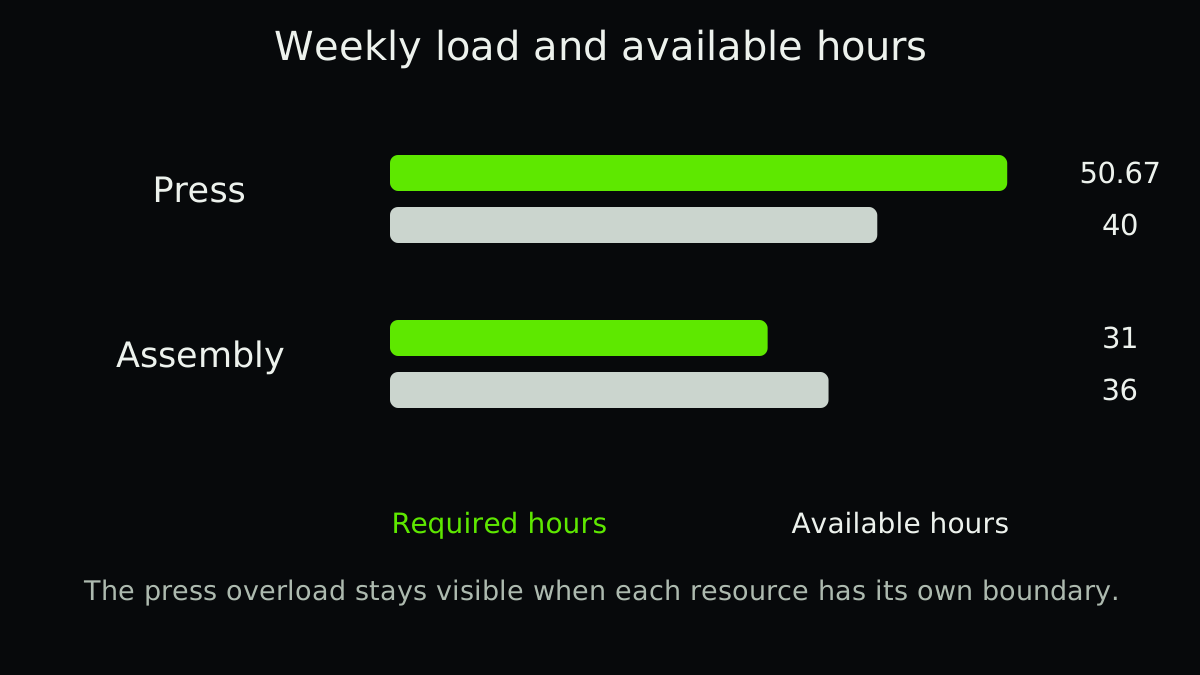
The press needs two 2-hour setups; assembly needs 1 hour in total. Required press time is 600×2/60 +400×4/60 +4 =50.67 hours. Assembly requires 600×1/60 +400×3/60 +1 =31 hours.
Use either explicit gross quantities and first-attempt times or a documented effective allowance. Mixing both can double-count losses.
| Resource | Run load | Setup load | Total required | Available |
|---|---|---|---|---|
| Press | 46.67 h | 4 h | 50.67 h | 40 h |
| Assembly | 30 h | 1 h | 31 h | 36 h |
Find the local overload before averaging resources
The press is short 10.67 hours. Assembly has 5 hours unallocated under this weekly model. A combined percentage understates the press shortage and does not identify its location. Spare assembly time cannot become press time.
If we hold A at 600 units, it consumes 20 press hours. After 4 setup hours, 16 of the 40 press hours remain for B. At 4 minutes per B unit, that supports 240 B units, leaving 160 of the 400-unit B demand outside the plan. This is an aggregate feasibility check, not an instruction to favor A commercially.
Test options with their actual constraints
Possible responses include a changed mix, a revised promise, qualified overtime, another approved route or shorter setups. Each option needs its own material, labor, tooling and quality checks. A spare machine that cannot run the required tool supplies no usable capacity for this order.
If the input times instead describe first attempts, gross up quantities using a stated routing and yield model. A simple good-demand/yield estimate may be useful for a stable single stage, but multi-stage scrap and rework require their own resource visits. See rolled throughput yield before multiplying average yields into a capacity promise.
- Fix the demand version
Keep quantities, due period and accepted-unit definition together.
- Calculate each resource load
Use routing-specific run times, setup events and explicit loss assumptions.
- Build available hours
Deduct known unavailable time once and check qualified staffing.
- Resolve overloads
Compare real alternatives before releasing the detailed schedule.
Check the sequence after the rough-cut pass
Weekly hours do not show whether material arrives on Thursday, whether two jobs need the same fixture at once or whether an operator is available during a machine handoff. Carry a feasible aggregate plan into production scheduling and check these collisions.
Retain setup assumptions by sequence or family. If a changed mix adds a cleaning cycle, the previous 4-hour press allowance may no longer hold. Keep an unchanged assumption visible rather than quietly calling the revised plan feasible.
Keep the promise and the model revision together
The resource download stores the fictional demand, times, setup hours and available hours, plus fields for your own check. Compare the eventual output with the planning assumptions to learn which allowance needs attention.
Keep the original plan beside each revised option. That makes it possible to explain which assumption changed the promise, rather than simply replacing the spreadsheet with a more optimistic one.
A related example from Abolfazl
Compare individual station cycles with demand instead of trusting their average.
In English, on founder Abolfazl’s personal blog. This is related reading, not an independent technical source.
Practical checklist
- Fix demand quantities and the planning week.
- Identify critical machines and qualified labor.
- Use consistent time units.
- Declare whether times already include normal losses.
- Count actual setup events.
- Deduct known unavailable time only once.
- Resolve each resource overload separately.
- Check material and sequencing before committing dates.
FAQ
FAQ
Sources and further reading
Authoritative references used to research and verify this guide.