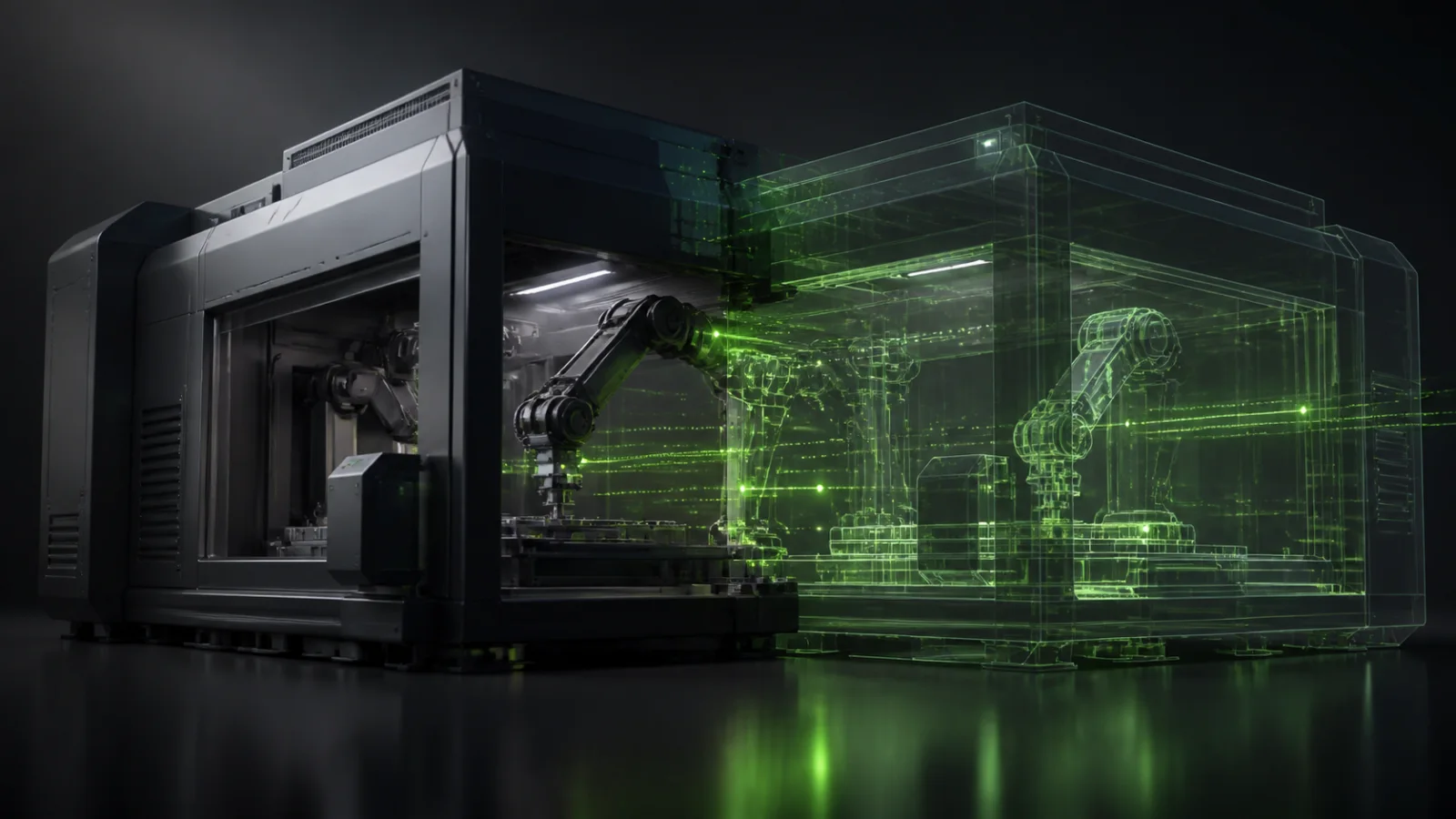
A digital twin in manufacturing is a synchronized virtual representation of a physical asset, process, line, or factory that supports a defined operational decision. It combines a model with current or periodically refreshed data so teams can observe behavior, diagnose causes, predict likely outcomes, and test changes. The useful question is not “Do we have a twin?” but “Which decision will this model improve, and how will we verify that its answer is credible?”
Fit-for-purpose model
Connected operational context
Validated scenario decisions
Start with the decision, not the 3D model
A digital twin is not simply a dashboard, CAD rendering, or one-off simulation. NIST describes manufacturing twins as synchronized models that can represent, diagnose, predict, and optimize operations. Synchronization can be real time, event driven, or periodic; the required frequency depends on the decision.
Define one decision first: whether to add a buffer, change a sequence, alter staffing, schedule maintenance, or release a new product mix. Set the system boundary, decision horizon, owner, and acceptable error. This prevents a costly “model everything” program with no operational outcome.
- Decision and accountable owner
- Physical boundary and time horizon
- Required outputs and acceptable uncertainty
- Refresh frequency justified by the use case
Connect the minimum data that explains behavior
Begin with the sources already available: PLC states and counters, IoT or condition sensors, historian events, MES production records, ERP orders, maintenance work, quality results, and manual CSV logs. Map each field to a model concept and retain its source, unit, timestamp, and quality status.
More data is not automatically better. A line-flow decision may need cycle times, failures, buffers, routing, schedules, and demand, not every vibration channel. Use machine learning where it adds evidence, such as detecting anomalous cycles or estimating a failure distribution, while keeping the transformation traceable.
- Asset identity and timestamp alignment
- States, counts, cycle times, failures, and quality
- Orders, schedules, product mix, routes, and staffing
- Missing-data rules, units, lineage, and access controls
Choose the model fidelity the decision needs
A fit-for-purpose twin may combine discrete-event simulation for flow, physics or degradation models for equipment, and statistical or machine-learning models for uncertain inputs. The most detailed model is not necessarily the most useful: extra detail adds calibration work and additional ways to be wrong.
Document assumptions and separate observed inputs from inferred values. Keep technical diagrams left-to-right when they represent material or event flow, even inside a right-to-left language page.
Validate before trusting a recommendation
Verification asks whether the software and equations were implemented correctly. Validation asks whether the model represents the real system well enough for its intended decision. NIST emphasizes verification, validation, and uncertainty quantification because a synchronized model can still produce a precise but wrong answer.
Compare the baseline with several operating periods, including unusual demand or downtime. Test throughput, queues, lead time, downtime, quality, and event timing, not one aggregate KPI. Revalidate after process, product, sensor, or control-logic changes.
- Verify
Check logic, units, routes, calculations, and repeatability.
- Calibrate
Estimate uncertain inputs from representative operating data.
- Validate
Compare outputs and event patterns with unseen periods.
- Quantify uncertainty
Show ranges and identify inputs that can reverse the decision.
- Govern change
Assign refresh triggers, approvals, and model ownership.
Turn predictions into controlled improvement
Use the twin to compare a baseline with explicit counterfactual scenarios. Report the expected system outcome, assumptions, confidence, effort, and safety or quality risks. AI can surface candidate problems and solutions; simulation can test propagation through the system; the operating team decides what to try.
Close the loop after implementation. Compare actual results with the prediction, record why they differed, and update the model. This learning cycle is what turns a digital twin from a presentation asset into durable continuous-improvement infrastructure.
A related example from Abolfazl
Follow a changing queue to separate a connected model from a validated forecast.
In English, on founder Abolfazl’s personal blog. This is related reading, not an independent technical source.
Practical checklist
- Name the exact operational decision and owner.
- Set the model boundary, horizon, and refresh frequency.
- Connect only data needed to explain the decision.
- Preserve units, timestamps, lineage, and quality flags.
- Choose model fidelity based on risk and required accuracy.
- Validate several system behaviors with unseen operating periods.
- Expose uncertainty and require human approval before action.
FAQ
FAQ
Sources and further reading
Authoritative references used to research and verify this guide.
- NISTDigital Twins for Advanced Manufacturing
- NISTDigital Twins for Advanced Manufacturing: The Standardized Approach
- NIST2026 Roadmap on Artificial Intelligence and Machine Learning for Smart Manufacturing
- NISTDigital Twins for Advanced Manufacturing
- SiemensFactory simulation planning: CPG use cases (2026)