

Calculate OTIF as eligible orders delivered both on time and in full divided by all eligible orders, multiplied by 100. Define the promised delivery window, receipt evidence, completeness rule and reporting cohort before scoring. A dispatch timestamp does not establish on-time customer receipt. Count the intersection of the two conditions at the agreed order or line level; multiplying separate on-time and in-full percentages generally gives the wrong result.
Calculate OTIF from identifiable orders rather than averaged percentages.
Separate dispatch promises from customer receipt.
Make partial deliveries and changed promises auditable.
Agree what the customer was promised
ASCM defines OTIF around meeting a delivery goal fully and by its delivery date. That leaves practical details to an explicit agreement: receipt location, date or time window, quantity, accepted substitutions and supporting evidence.
A plant can dispatch every pallet before its own cutoff and still miss the customer’s receiving window. Keep dispatch-on-time as a useful separate metric, but do not silently label it delivered-on-time.
This guide scores customer delivery. Production scheduling addresses the plan that makes it possible; a good schedule alone cannot prove receipt.
Freeze the scoring rules before the report
Use the original agreed promise or a contractually defined revised promise. Retain both and the reason for change. Continually moving the promised date to the actual date makes performance appear perfect without improving delivery.
Choose a cohort, such as orders promised for receipt during a calendar month, including overdue orders still open at the cutoff. Scoring only completed deliveries removes some of the worst failures from the denominator.
Define cancellations, customer holds, damaged or rejected goods and partial deliveries. If receipt evidence is missing, mark the uncertainty and follow the reporting policy; do not assume a dispatch scan means success.
The same order IDs and cohort define on-time, in-full and the combined measure. Zero eligible orders means not applicable, not 100%.
Ten orders show why multiplication fails
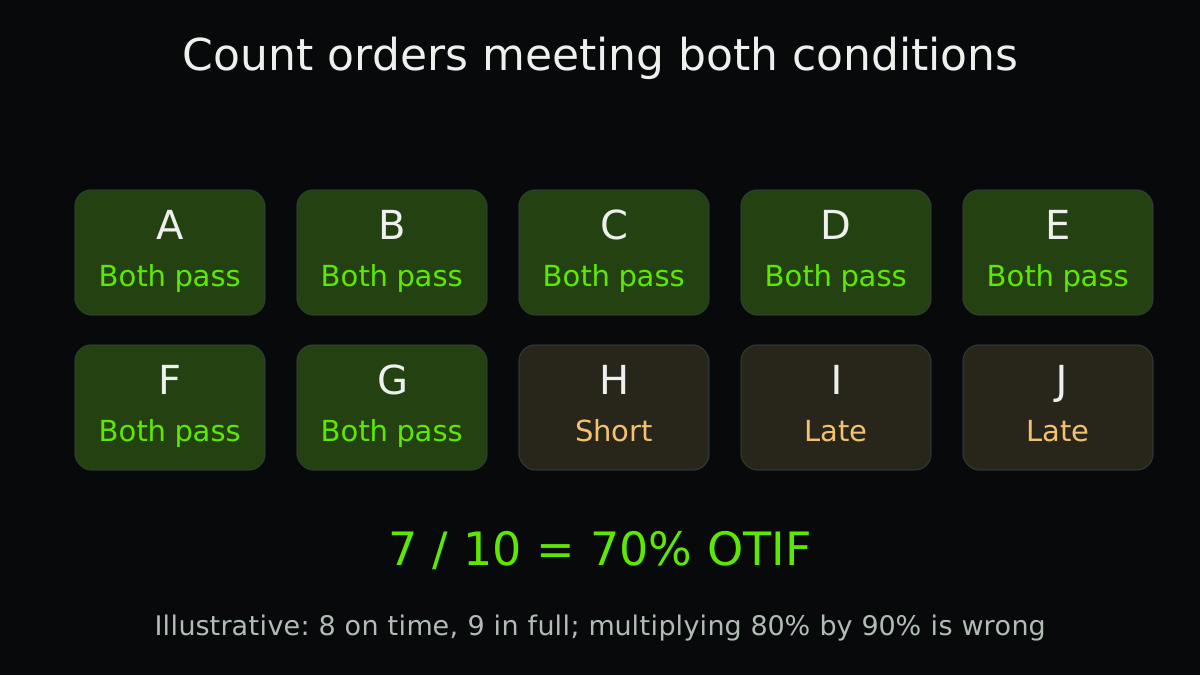
Illustrative example: ten eligible orders were promised for the same reporting period. Seven meet both conditions. Order H arrives on time but short. Order I arrives complete but late. Order J also arrives complete but late.
On-time is 8 / 10 = 80%. In-full is 9 / 10 = 90%. OTIF is 7 / 10 = 70%. Multiplying 80% by 90% gives 72%, which describes no observed seven-order intersection. Use the order records instead.
| Orders | On time? | In full? | Pass OTIF? |
|---|---|---|---|
| A–G: seven orders | Yes | Yes | Seven passes |
| H: one order | Yes | No | No |
| I–J: two orders | No | Yes | No |
Do not mix orders, lines and units
An order containing 20 lines has more ways to fail than a single-line order. A line-level score can help diagnose the misses, but it is not directly comparable with an all-lines order-level score.
Unit-weighted delivery measures can also be useful when one order is very large. Label that weighting. A large successful order should not accidentally erase several small missed customer commitments.
- Create the promised cohort
List order IDs due in the window, including open overdue commitments under the agreed policy.
- Join delivery evidence
Use accepted receipt quantities and times at the agreed destination, with timezone and evidence status.
- Score each condition
Apply the frozen timing and completeness rules to the same order or line.
- Review failed intersections
Separate late-only, short-only and both failures. Retain evidence, cause investigation and eventual recovery.
Find where the promise broke
Trace failures through release, material availability, production completion, dispatch, transit and receiving. A manufacturing delay and a customer receiving hold need different responses.
Use a manufacturing KPI tree to connect schedule adherence and production output to delivery. Avoid claiming that a higher local machine utilization necessarily improves OTIF.
Segment product families, routes and order sizes without changing the original definition. A small monthly percentage needs its numerator and denominator beside it.
Keep an auditable promise history
A practical record includes order and line ID, accepted ordered quantity, original and revised promised windows, actual accepted receipt, reporting cutoff and exception approval. GS1’s EPCIS standard provides a broader event-recording framework for what happened, when and where; using it does not by itself define your OTIF rules.
ASCM’s SCOR Perfect Customer Order Fulfillment includes documentation and condition as well as quantity and timing. It is broader than a two-condition OTIF score, so keep the measures separately named.
Report unknown evidence alongside the score. Once the record is reliable, compare periods with the same rules and discuss the specific failures, not just a target percentage. The metrics guide helps assign a decision owner.
Practical checklist
- Name the customer receipt location and time window.
- Freeze the promise-date policy.
- Choose order, line or unit weighting explicitly.
- Include eligible open overdue commitments.
- Define partial, damaged and substituted deliveries.
- Retain receipt evidence and timezone.
- Count the same-record intersection.
- Report failed and unknown cases alongside the score.
FAQ
FAQ
Sources and further reading
Authoritative references used to research and verify this guide.