

OEE measures loss inside the time you scheduled to produce. Utilization measures how much of the calendar you scheduled at all. TEEP combines them: TEEP = OEE × utilization, so it measures productive output against all calendar time. A plant that runs two 8-hour shifts a day at 75% OEE has 66.7% utilization and 50% TEEP. Low TEEP is not automatically bad. It only matters if demand needs the unused capacity.
One example showing all three metrics on the same day
A decision matrix that links each metric to a question
A clear warning about chasing utilization for its own sake
Three metrics, three slices of time
The three metrics use different denominators, and that is the whole difference. OEE looks only at the time you planned to produce. Utilization compares that planned time with the calendar. TEEP, total effective equipment performance, measures good output at the ideal rate against every hour on the calendar.
Definitions of utilization vary between companies, so state yours. In this article utilization means scheduled production time ÷ calendar time.
- OEE: loss inside planned production time.
- Utilization: how much calendar time was scheduled for production.
- TEEP: fully productive time ÷ calendar time, which equals OEE × utilization.
Use OEE to find losses inside scheduled time, utilization to see how much time is scheduled, and TEEP to see total potential.
A one-day example
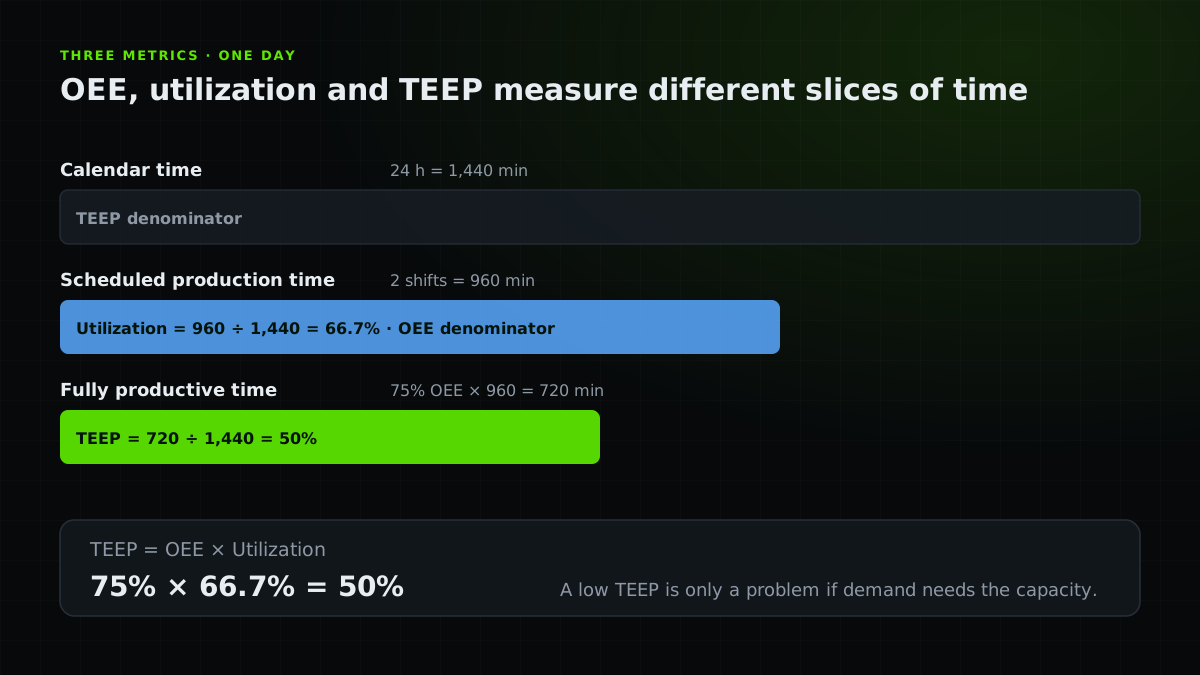
A line has 1,440 minutes of calendar time in a day. It is scheduled for two 8-hour shifts, or 960 minutes. Inside those shifts it achieves an OEE of 75%, which means 720 fully productive minutes.
Utilization is 960 ÷ 1,440 = 66.7%. TEEP is 720 ÷ 1,440 = 50%, which is also 75% × 66.7%.
Which question each metric answers
Vrolen’s view is that a metric is only as useful as the decision it supports. The table maps the three metrics, plus the question none of them can answer alone.
| Question | Metric |
|---|---|
| Why did scheduled production lose time or output? | OEE |
| Are we scheduling enough of the available asset time? | Utilization |
| What is the theoretical productive potential across every hour? | TEEP |
| Will recovering this capacity increase customer output? | None alone. Analyze the system constraint. |
A low TEEP is not automatically bad
If demand only needs one shift, unused calendar time is a choice, not a loss. A plant that adds work to lift a utilization number builds inventory it cannot sell. The healthy use of TEEP is to size an investment decision: before buying a second line, check how much fully productive time the first one leaves on the table.
Use OEE to find the losses inside scheduled time, and use the constraint to decide whether recovering them matters. The theory of constraints and bottleneck analysis guides show how.
- Demand
How much good output does the customer require?
- Capacity
How much can the constraint produce in the scheduled time?
- Loss
Which OEE losses stand between the two?
- Calendar
Only then ask whether more scheduled time is worth its cost.
When each metric lies to you
OEE lies when planned time is redefined to flatter the score. Utilization lies when machines are kept busy building inventory. TEEP lies when it is used as a target for a resource that has no demand behind it.
Pair all three with throughput at the constraint, lead time and on-time delivery. Vrolen’s operational excellence metrics article explains how to connect them into one hierarchy.
Practical checklist
- State the definition of utilization you are using.
- Calculate OEE only inside scheduled production time.
- Calculate TEEP against the full calendar for the period.
- Check demand before treating unused calendar time as loss.
- Use TEEP to size capacity decisions, not to set shift targets.
- Look at the constraint before deciding which loss to recover.
- Report throughput and delivery next to all three metrics.
- Never compare plants that define scheduled time differently.
FAQ
Questions before you join
Sources and further reading
Authoritative references used to research and verify this guide.