

Manufacturing software should be organized around responsibilities and information flows, not acronyms alone. ERP typically plans business resources and logistics; MES executes and tracks production; MOM is the broader set of production, quality, maintenance, and inventory operations activities; QMS governs quality processes; CMMS or EAM manages asset maintenance; historians and industrial platforms preserve time-series data; and improvement platforms connect evidence to change. Actual product boundaries vary, so ownership must be explicit.
Clear system responsibilities based on operating decisions
Fewer duplicate records and fragile point-to-point integrations
A staged architecture that connects planning, execution, analysis, and improvement
Use ISA-95 as a boundary map, not a shopping list
ISA-95 describes activities and information exchange between enterprise planning and manufacturing operations and control. Level 0 is the physical process; levels 1 and 2 sense, manipulate, and supervise it; level 3 covers manufacturing operations management; level 4 covers business planning and logistics.
Modern cloud, edge, and event architectures do not always resemble a strict pyramid, but the activity boundaries remain useful. Start with who makes which decision, at what time horizon, from which authoritative data, and with what consequence. Then assign systems.
- Business planning, demand, finance, and logistics
- Production, quality, maintenance, and inventory operations
- Supervisory control, PLC logic, sensing, and actuation
- Analytics, modeling, collaboration, and improvement workflows
- Master data, identity, security, lineage, and integration services
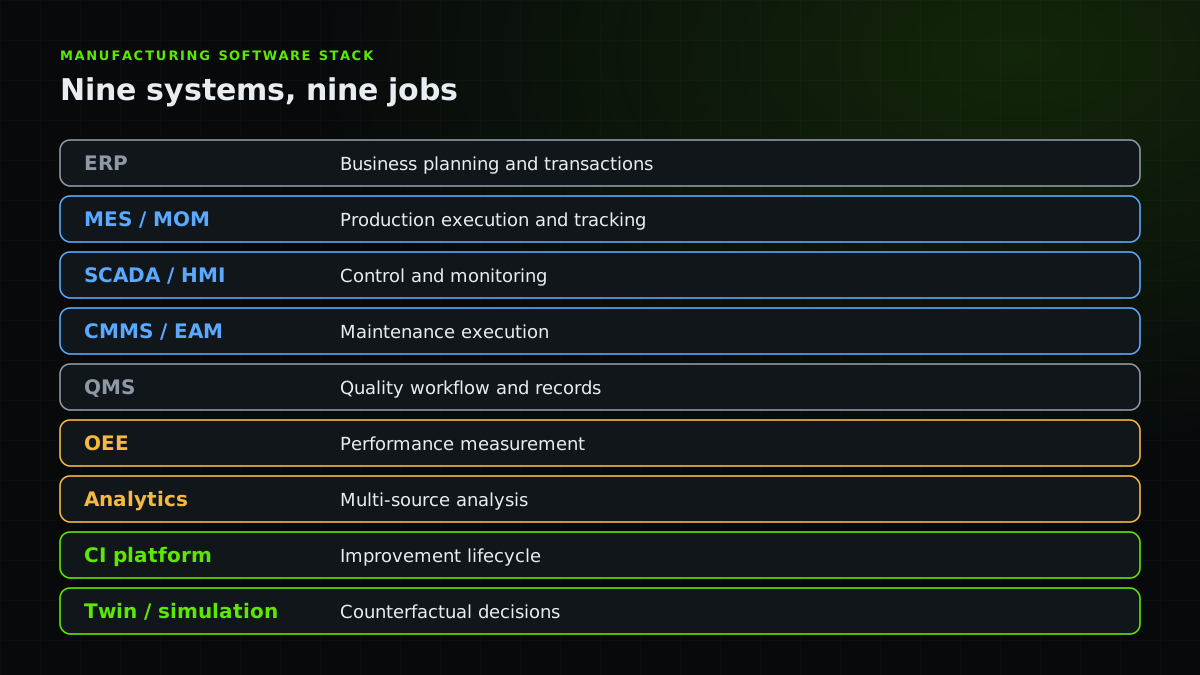
The software stack at a glance
Each system in the stack has one main job. Most integration trouble appears where two of them claim the same job, so name an owner for each.
See alsoMES vs OEE vs analyticsManufacturing analytics software
Distinguish ERP, MES, and MOM by responsibility
ERP commonly owns orders, purchasing, inventory valuation, financials, and higher-level planning. MES commonly dispatches and tracks production, resources, genealogy, work instructions, and execution status. MOM describes the broader domain that also includes quality, maintenance, and inventory operations; a vendor may use MES and MOM differently.
Do not decide from the label. Build a capability and data-ownership matrix. For each object, asset, material, order, recipe, route, lot, result, downtime event, maintenance work, and specification, name the source of truth, permitted writers, consumers, latency, and reconciliation rule.
Place quality, maintenance, data, and improvement systems deliberately
QMS manages controlled quality processes such as nonconformance, audit, document control, CAPA, and supplier quality. CMMS or EAM manages asset hierarchy, work, plans, labor, and spares. Historians capture high-frequency industrial time series; data platforms add context, transformation, and cross-system analysis.
Improvement software should connect the operating evidence to hypotheses, scenarios, actions, approvals, and verified benefit. It should not silently become another MES, QMS, or data lake. Choose a governed reference or integration instead of copying records without ownership.
- Map decisions
List the decisions, actors, horizon, evidence, and consequence.
- Assign ownership
Choose the authoritative system and permitted writers for each object.
- Define contracts
Specify identity, units, timestamps, quality, events, and failure handling.
- Integrate by value
Deliver one bounded workflow before building a universal data layer.
- Operate the architecture
Monitor lineage, latency, reconciliation, security, and change.
Compare suite, best-of-breed, and composable approaches
A suite can reduce interfaces and vendor coordination but may offer uneven depth and stronger lock-in. Best-of-breed tools can fit specialist work but require integration, identity, support, and semantic governance. A composable architecture can evolve in smaller parts but transfers design responsibility to the manufacturer.
Score options against operating scenarios and lifecycle cost: configuration, validation, migration, interfaces, edge infrastructure, offline behavior, upgrades, support, security, training, and exit. The cheapest subscription can become the most expensive architecture if every change requires custom reconciliation.
Modernize in decision-sized increments
Do not wait for a perfect enterprise data model. Select a valuable workflow such as downtime response, quality containment, schedule adherence, or improvement prioritization. Define the minimum information contract, integrate it, measure the decision, and use what you learn to extend the architecture.
Protect control-system safety and availability. Use segmented networks, least privilege, managed identities, signed changes, monitoring, recovery tests, and clear cloud/edge boundaries. Real-time connectivity expands value and attack surface together.
A related example from Abolfazl
Follow one order through system handoffs that count different things.
In English, on founder Abolfazl’s personal blog. This is related reading, not an independent technical source.
Practical checklist
- Map operating decisions before selecting product categories.
- Use ISA-95 activities to clarify enterprise, operations, and control boundaries.
- Assign a source of truth and write authority for every shared object.
- Define identity, units, timestamps, event meaning, and reconciliation.
- Compare suites and specialist tools over the full lifecycle.
- Pilot one bounded workflow and measure its operating decision.
- Design cybersecurity, offline behavior, recovery, and change management.
- Require usable export and an exit path for data and workflows.
FAQ
FAQ
Sources and further reading
Authoritative references used to research and verify this guide.