
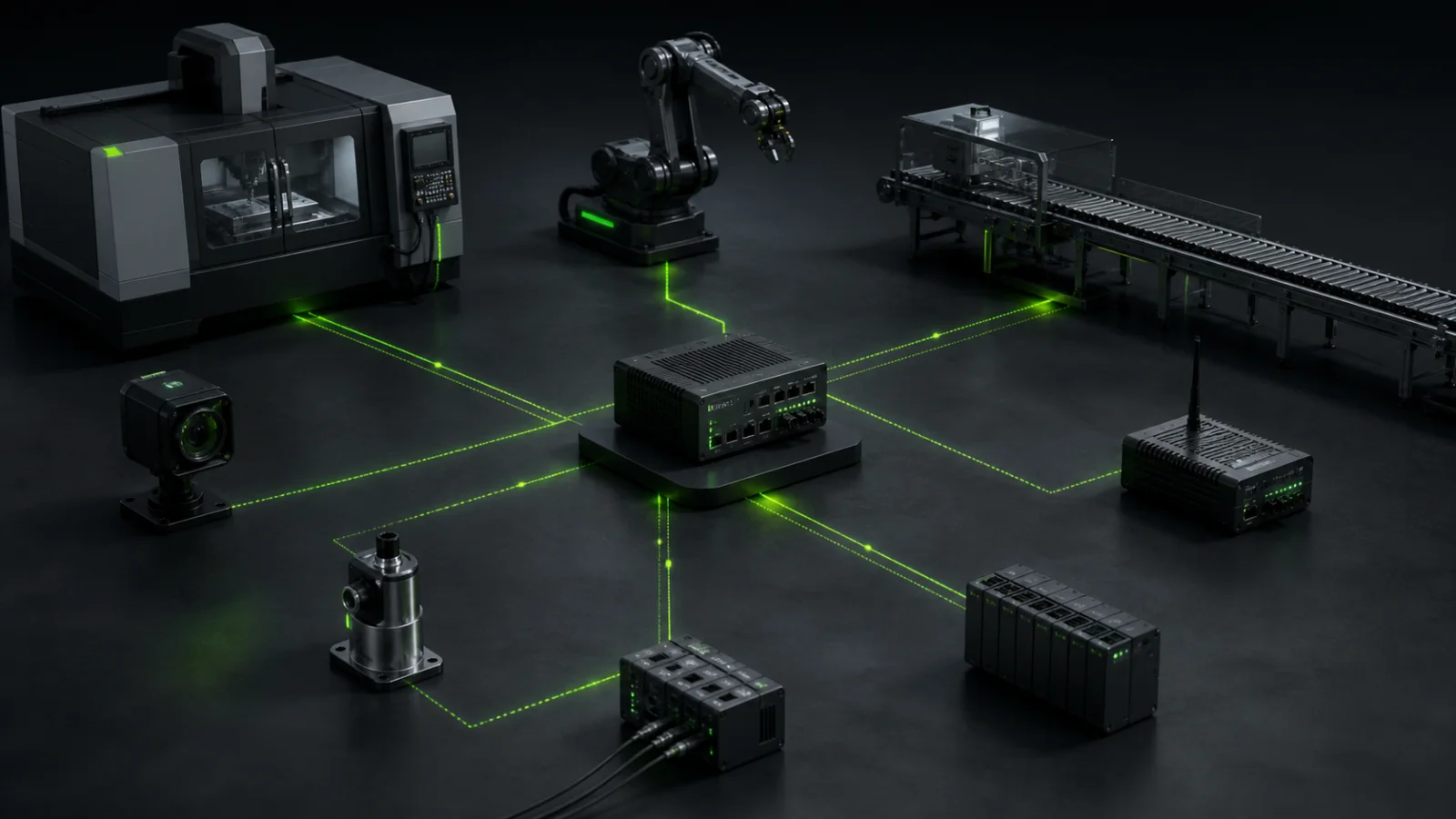
Design an IIoT path from sensors and PLCs to interoperable context, secure analytics, and operational action. Start from an operational use case, inventory existing PLC and sensor data, define common context and units, choose edge versus cloud responsibilities, secure device identity and transport, and monitor data quality end to end. Connectivity without semantics creates more data but not more understanding. Unmanaged devices, flat networks, inconsistent tags, and missing ownership enlarge operational and cybersecurity risk. Industrial IoT and smart manufacturing: AI and automation may accelerate analysis, but people remain responsible for safety, quality, interpretation, and approval.
Interoperable operating context
Reliable real-time data
Secure analytics foundation
Start with the operational decision, not connectivity
Design an IIoT path from sensors and PLCs to interoperable context, secure analytics, and operational action.
Connectivity without semantics creates more data but not more understanding. Unmanaged devices, flat networks, inconsistent tags, and missing ownership enlarge operational and cybersecurity risk. Industrial IoT and smart manufacturing: Use evidence from the real process and keep source, timestamp, unit, and uncertainty visible.
- asset identity and semantics
- time-synchronized signals
- edge and network reliability
- security and access requirements
Give every signal identity, time, unit, and context
Industrial IoT and smart manufacturing: Use evidence from the real process and keep source, timestamp, unit, and uncertainty visible. Focus on asset identity and semantics, time-synchronized signals, edge and network reliability, security and access requirements.
Start from an operational use case, inventory existing PLC and sensor data, define common context and units, choose edge versus cloud responsibilities, secure device identity and transport, and monitor data quality end to end. Industrial IoT and smart manufacturing: Preserve a baseline and change one important assumption at a time so the team can explain the result.
- asset identity and semantics
- time-synchronized signals
- edge and network reliability
- security and access requirements
Design edge, network, and cloud responsibilities
Start from an operational use case, inventory existing PLC and sensor data, define common context and units, choose edge versus cloud responsibilities, secure device identity and transport, and monitor data quality end to end.
Connectivity without semantics creates more data but not more understanding. Unmanaged devices, flat networks, inconsistent tags, and missing ownership enlarge operational and cybersecurity risk. Industrial IoT and smart manufacturing: Preserve a baseline and change one important assumption at a time so the team can explain the result.
Secure the data path and degraded mode
Industrial IoT and smart manufacturing: Use simulation or a controlled pilot when interactions, queues, failures, mix, or timing could move the effect elsewhere. Start from an operational use case, inventory existing PLC and sensor data, define common context and units, choose edge versus cloud responsibilities, secure device identity and transport, and monitor data quality end to end.
Connectivity without semantics creates more data but not more understanding. Unmanaged devices, flat networks, inconsistent tags, and missing ownership enlarge operational and cybersecurity risk.
- Start with the operational decision, not connectivity
Design an IIoT path from sensors and PLCs to interoperable context, secure analytics, and operational action.
- Give every signal identity, time, unit, and context
Industrial IoT and smart manufacturing: Use evidence from the real process and keep source, timestamp, unit, and uncertainty visible.
- Design edge, network, and cloud responsibilities
Start from an operational use case, inventory existing PLC and sensor data, define common context and units, choose edge versus cloud responsibilities, secure device identity and transport, and monitor data quality end to end.
- Secure the data path and degraded mode
Industrial IoT and smart manufacturing: Use simulation or a controlled pilot when interactions, queues, failures, mix, or timing could move the effect elsewhere.
- Operate data quality as part of production
Industrial IoT and smart manufacturing: Assign an owner, review date, response rule, and success measure. Compare the observed result with the prediction and update the standard.
Operate data quality as part of production
Industrial IoT and smart manufacturing: Assign an owner, review date, response rule, and success measure. Compare the observed result with the prediction and update the standard.
Industrial IoT and smart manufacturing: AI and automation may accelerate analysis, but people remain responsible for safety, quality, interpretation, and approval. Connectivity without semantics creates more data but not more understanding. Unmanaged devices, flat networks, inconsistent tags, and missing ownership enlarge operational and cybersecurity risk.
A related example from Abolfazl
Compare reporting and controller changes by the consequence of interruption.
In English, on founder Abolfazl’s personal blog. This is related reading, not an independent technical source.
Practical checklist
- Design an IIoT path from sensors and PLCs to interoperable context, secure analytics, and operational action.
- Industrial IoT and smart manufacturing: Use evidence from the real process and keep source, timestamp, unit, and uncertainty visible.
- Industrial IoT and smart manufacturing: Preserve a baseline and change one important assumption at a time so the team can explain the result.
- Start from an operational use case, inventory existing PLC and sensor data, define common context and units, choose edge versus cloud responsibilities, secure device identity and transport, and monitor data quality end to end.
- Industrial IoT and smart manufacturing: Use simulation or a controlled pilot when interactions, queues, failures, mix, or timing could move the effect elsewhere.
- Industrial IoT and smart manufacturing: Assign an owner, review date, response rule, and success measure. Compare the observed result with the prediction and update the standard.
- Industrial IoT and smart manufacturing: AI and automation may accelerate analysis, but people remain responsible for safety, quality, interpretation, and approval.
FAQ
FAQ
Sources and further reading
Authoritative references used to research and verify this guide.