
MES executes and tracks work orders. OEE and monitoring software measure machine state and loss. Manufacturing analytics combines data to analyze decisions. A continuous improvement platform manages the improvement lifecycle. Simulation tests scenarios, and CMMS manages maintenance. A plant rarely needs one platform to replace all of them. Decide by the job: system of record, system of execution, system of analysis and system of improvement.
A matrix from need to software layer
A four-layer model with an owner for each job
Guidance on overlap between products
Start from the job, not the acronym
Vendors use MES, MOM, OEE, analytics and CI in overlapping ways, so product names do not tell you what a system does. Start from the job you need done, and then find the layer that owns it.
| Need | Typical layer |
|---|---|
| Execute and track work orders | MES |
| Measure machine state and OEE | OEE and production monitoring |
| Combine data to analyze decisions | Manufacturing analytics |
| Manage the improvement lifecycle | Continuous improvement platform |
| Test counterfactual scenarios | Simulation or digital twin |
| Manage maintenance execution | CMMS or EAM |
Four layers, four jobs
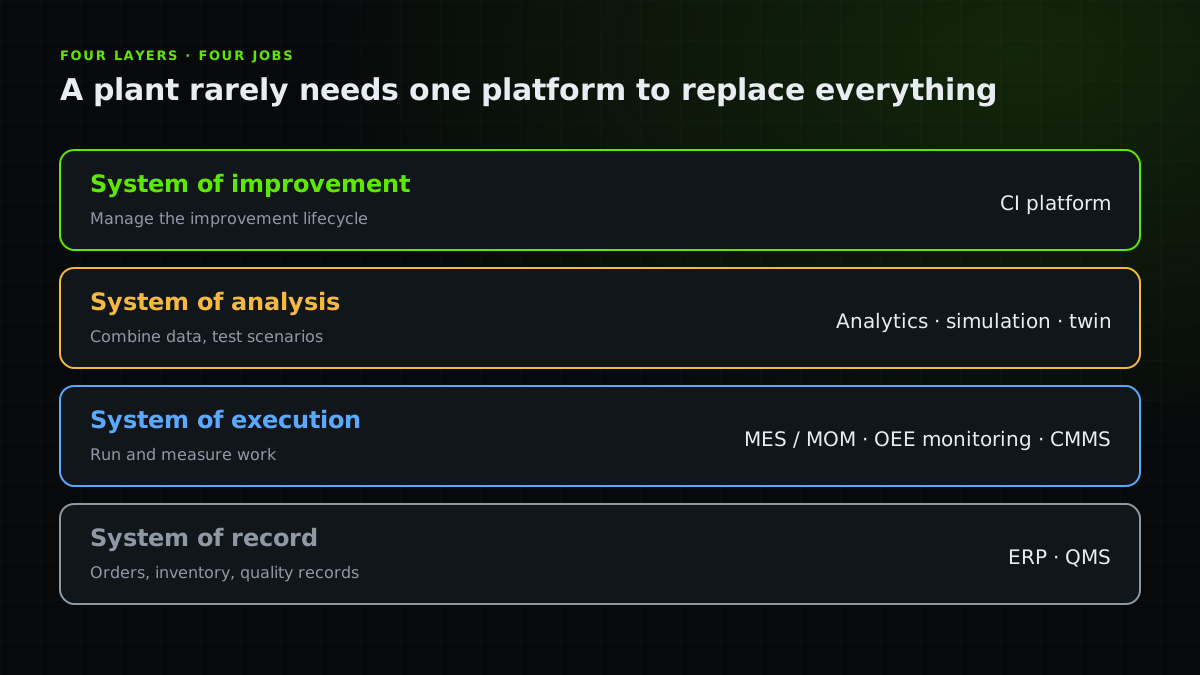
A useful architecture defines what is the system of record, of execution, of analysis and of improvement. The layers can share products, but each job needs a clear owner.
- System of record: ERP and QMS hold orders, inventory and quality records.
- System of execution: MES or MOM, OEE monitoring and CMMS run and measure work.
- System of analysis: analytics, simulation or a twin combine data and test scenarios.
- System of improvement: a CI platform manages problems, experiments, actions and verified results.
Where each one stops
Each layer has a natural limit, and problems start when one is asked to do another’s job.
| Layer | Strong at | Usually not the place for |
|---|---|---|
| MES | Dispatching, tracking, genealogy, work instructions | Cross-system analysis of causes; scenario testing |
| OEE monitoring | Live state, stop capture, loss categories | Deciding which loss matters to the system |
| Analytics | Combining sources; diagnosis; prediction | Owning the workflow that acts on findings |
| CI platform | Problems, experiments, actions, verification | Executing production; replacing the MES |
| Simulation and twin | Testing changes to flow and schedules | Recording what happened |
| CMMS | Maintenance work, plans, parts | Production-flow decisions |
How to decide what you are missing
A quick way to find the gap is to trace one recurring problem through your systems. Where does the trail break? The break tells you which layer is missing or weak. Real-time visibility is covered in real-time production monitoring, and the wider map of systems and ownership is in the manufacturing software guide.
- Pick a recurring problem
For example, repeated stops on one line.
- Trace the evidence
Can you see the event, its context and its history?
- Trace the analysis
Can you combine sources to explain it?
- Trace the response
Is there an owned action with verification?
- Trace the learning
Is the outcome recorded for the next case?
The key message: you rarely need one platform to replace everything
Suites reduce integration but can offer uneven depth. Specialist tools fit specialist jobs but need integration and shared definitions. Choose by the decisions you must support, and see continuous improvement software and the analytics buyer’s guide for how to evaluate each.
Common mistakes when choosing a layer
Most stack problems come from asking one layer to do another layer’s job.
- Buying an MES to fix an analysis problem.
- Expecting OEE software to explain causes.
- Duplicating master data across layers without an owner.
- Choosing a suite for one strong module and accepting weak ones.
- Leaving the improvement workflow in spreadsheets and email.
Practical checklist
- List the jobs you need done before listing products.
- Assign each job to a layer with a named owner.
- Identify the source of truth for orders, assets and quality.
- Trace one recurring problem through every layer.
- Note where the trail breaks.
- Avoid asking one layer to do another layer’s job.
- Agree metric definitions across systems.
- Plan exports and integrations before buying.
FAQ
Questions before you join
Sources and further reading
Authoritative references used to research and verify this guide.