
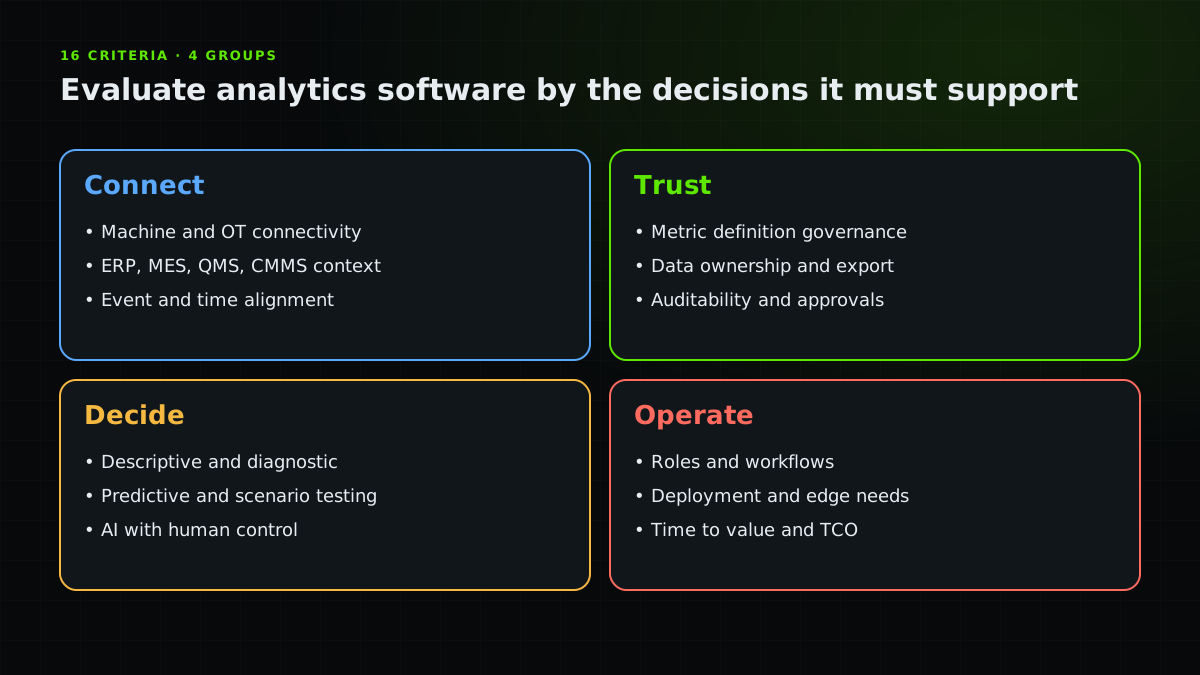
Evaluate manufacturing analytics software by the decisions it must support, not by the feature list. Score it on sixteen criteria in four groups: connect (machine and business data), trust (definitions, ownership, audit), decide (descriptive to scenario testing and AI) and operate (roles, deployment, time to value, cost). Choose among six categories of software by where your data lives and which decisions you cannot resolve today. Vrolen makes software in one of these categories, so read the framework with that in mind.
Sixteen criteria in four groups
Six vendor categories and when each is appropriate
A disclosure and a framework instead of an invented top ten
The market is moving from reporting to decisions
ISG’s 2026 Buyers Guide for Manufacturing Analytics, which evaluates 16 software providers, describes analytics platforms increasingly used to integrate operational and enterprise data, enable predictive maintenance and optimize production performance in real time, with AI, edge analytics and emerging agentic capabilities pushing toward predictive, prescriptive and increasingly automated operations.
That shift changes what to ask a vendor. A dashboard that reports last week’s scrap is a different purchase from a system that helps decide what to change next.
Why this page has no “top ten”
Naming and ranking specific vendors without a documented, reproducible evaluation would be guesswork dressed as advice, and Vrolen is itself a vendor. So this guide gives a framework and a category map you can apply to any shortlist. Vrolen makes decision-support software for continuous improvement, which is one of the categories below.
Sixteen criteria in four groups
Score each candidate against the decisions you actually need to make. Not every criterion matters equally, and weights should reflect your plant.
| Group | Criteria |
|---|---|
| Connect | OT and machine connectivity; ERP, MES, QMS and CMMS context; event and time alignment |
| Trust | Metric-definition governance; data ownership and export; human approval and auditability |
| Decide | Descriptive analytics; diagnostic and root-cause support; predictive analytics; simulation or scenario capability; AI and agentic workflow |
| Operate | Role-based use; edge and offline needs; deployment model; time to value; total cost of ownership |
Six vendor categories and when each fits
Most products sit mainly in one category, even when marketing suggests otherwise. Knowing the category tells you what it is likely to do well.
| Category | Fits when | Watch for |
|---|---|---|
| BI platforms configured for manufacturing | You have clean data and analysts who can build the views | Shop-floor context and event data need heavy modeling |
| MES and MOM analytics | Execution data is already in the MES and the questions are about it | Limited view of data outside the MES |
| OEE and production monitoring | You need machine-state visibility and OEE quickly | Strong on measuring loss, lighter on causes and scenarios |
| Industrial data platforms | You need to unify many sources at scale | A foundation, not an answer to a decision |
| Decision-centric improvement platforms | The problem is deciding what to change, and testing it first | Newer category; check maturity and how assumptions are shown |
| Digital twin and simulation platforms | You must test changes to flow, schedules or capacity | Model build and upkeep effort. See twin vs simulation vs process mining |
Ask for evidence, not demos
Run each shortlisted product against the same real decision, with your data. The manufacturing data analytics guide covers what the data must look like, and the manufacturing software guide shows where analytics sits beside ERP, MES and quality systems. For where a new tool ends and another begins, read MES vs OEE vs analytics.
- Pick one decision
For example, which recurring stop to investigate, or which schedule to release.
- Set the success measure
What outcome would show the decision improved?
- Give every candidate the same data
A representative slice, including messy periods.
- Check the reasoning
Can you see how it reached its answer and what it assumed?
- Ask about exit
Can you export your data and definitions if you leave?
Common mistakes when buying analytics software
These mistakes are why demos look better than pilots.
- Scoring features instead of decisions.
- Judging the demo dataset instead of your own messy data.
- Ignoring who will maintain metric definitions after go-live.
- Underestimating integration effort with ERP, MES and machine data.
- Forgetting the exit: export of your data and definitions.
Practical checklist
- Name the decisions the software must help you make.
- Weight the sixteen criteria for your plant.
- Identify the category each candidate belongs to.
- Test every candidate on the same real decision and data.
- Check that metric definitions are governed and visible.
- Confirm human approval and an audit trail for AI outputs.
- Ask what happens to your data and definitions on exit.
- Estimate time to value and total cost, including integration.
FAQ
Questions before you join
Sources and further reading
Authoritative references used to research and verify this guide.