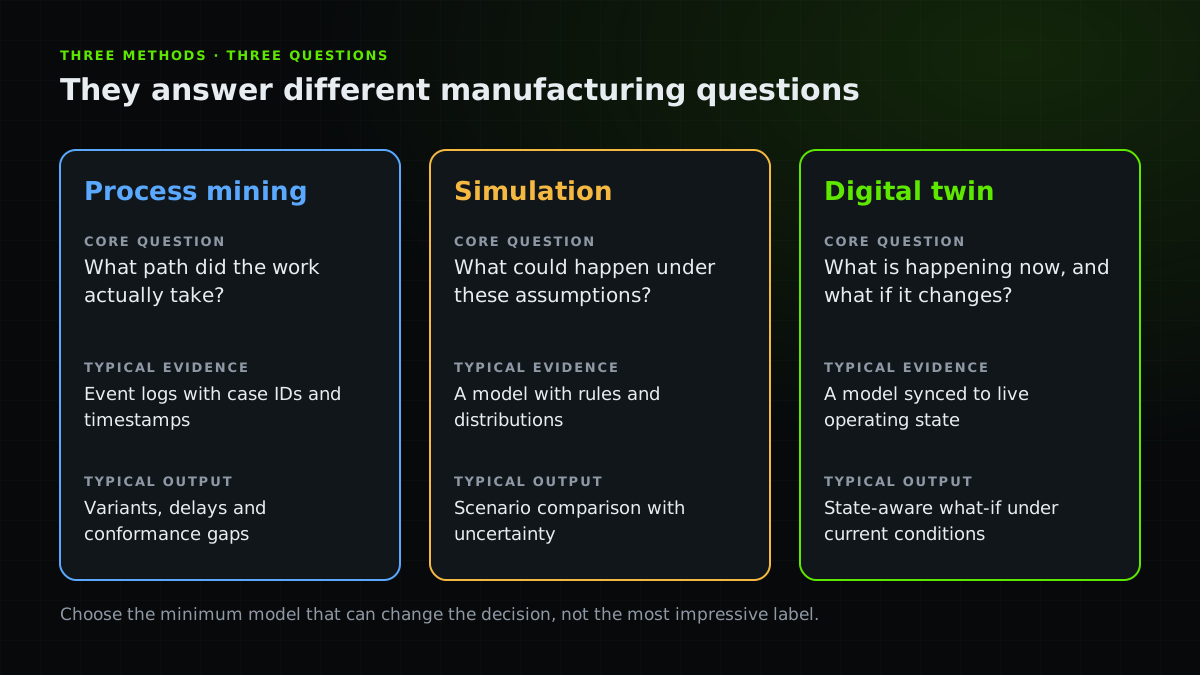
Process mining shows what path work actually took, from event logs. Simulation shows what could happen under stated assumptions, from a model. A digital twin connects a model to live operating state so you can ask what is happening now and what happens if conditions change. They are not rankings of sophistication. Choose the minimum model that can change your decision, then add fidelity only when the decision demands it.
A comparison by question, evidence and output
A rule for choosing the minimum useful model
A 2026 example of simulation becoming an operational tool
Three methods, three questions
These terms are often used as if they were versions of the same thing. They are not. Each starts from a different question, uses different evidence and produces a different kind of answer.
| Method | Core question | Typical evidence |
|---|---|---|
| Process mining | What path did the work actually take? | Event logs with case IDs and timestamps |
| Simulation | What could happen under these assumptions? | A modeled process with rules and distributions |
| Digital twin | What is happening now, and what may happen if conditions change? | A connected model plus live operating state |
| Statistical or ML model | What pattern predicts an outcome? | Historical and current features |
Use process mining when you do not know what really happened
Process mining reconstructs how orders or products actually moved from event data. It reveals variants, loops and delays that the standard process does not show. It is descriptive: it tells you what did happen, and it cannot tell you what would happen after a change. See process mining in manufacturing.
Use simulation when you need to test a change before you make it
Simulation runs a model of the process, with its rules and variation, to compare options. It is the right tool for questions such as “what happens to throughput if we add a buffer, change the batch size or reorder the schedule?” Its answers are only as good as the assumptions, so those must stay visible. NIST’s open-source Simantha project shows the approach for manufacturing systems.
Simulation is also how you test what happens when the constraint moves and how a schedule holds up under disruption.
Use a digital twin when the model must track the plant as it runs
A digital twin adds a live connection: the model reflects current state, so you can ask what is happening now and test what would happen next. It costs more to build and to keep synchronized, so it earns its place only when the decision depends on current state.
Siemens describes this shift in a 2026 post on factory simulation planning: a simulation model built to plan a launch can become an operational digital twin that reflects the plant as it runs today, with role-based applications for planners and plant leaders. For the fundamentals of what a twin is, see digital twin in manufacturing.
Do not buy a “digital twin” because the name sounds more advanced
A better question than “do we need a twin?” is “what is the minimum model that can change the decision?” Work up the ladder only as far as the decision requires.
- State the decision
What will change depending on the answer?
- Try the data you have
Can a simple analysis or a process-mining view answer it?
- Add a model if you must test alternatives
Use simulation with visible assumptions.
- Connect it to live state only if timing matters
Otherwise a periodically updated simulation is enough.
- Verify against reality
Compare predictions with what happened, and refine.
Common mistakes when choosing a model
Each of these is a way to spend months on a model that does not change the decision.
- Buying a twin to answer a question process mining could settle.
- Building a simulation without validating it against real output.
- Leaving assumptions undocumented, so results cannot be reproduced.
- Treating a one-time model as if it were connected to live state.
- Modeling the whole plant when one constraint decides the question.
Practical checklist
- Write down the decision before choosing the method.
- Use process mining to learn what actually happened.
- Use simulation to compare options under visible assumptions.
- Use a digital twin only if the decision depends on current state.
- Keep assumptions and data sources documented.
- Validate the model against real outcomes.
- Keep people accountable for decisions the model informs.
- Add fidelity only when a decision needs it.
FAQ
Questions before you join
Sources and further reading
Authoritative references used to research and verify this guide.