

Every part every interval, or EPEI, describes how often a process returns to each product in a defined repeating mix. Check whether the run load and complete cycle of setups fit inside the proposed interval. A short interval needs enough capacity for frequent changeovers, not just a smaller batch quantity. This fictional three-product example compares one-day and two-day wheels and explains why an average capacity calculation cannot settle sequence-dependent or delivery constraints.
Calculate the setup budget behind a repeat interval.
Compare a shorter wheel with a measured setup change.
Keep a capacity lower bound separate from an executable schedule.
Define the products included in the repetition
Lean Enterprise Institute uses Every Product Every Interval, also called EPEx, for how often a process produces its different assigned part numbers. EPEI is a common related term. State the included products, demand basis and time unit before comparing intervals.
A product wheel is a chosen recurring sequence. It may support the interval, but does not make demand constant or guarantee that every order meets its promise. Separate recurring families from exceptional products that need another planning rule. Heijunka provides the broader leveling context.
Calculate daily run load before spending setup time
Our illustrative single resource has 480 available minutes per day. Daily demand is 100 A units at 1 minute each, 80 B at 2 minutes and 40 C at 3 minutes. Run load is 100+160+120 =380 minutes per day, leaving 100 minutes per day for setups and any explicitly unallocated work.
The repeating A-B-C-A sequence has three 45-minute changeovers, including the return from C to A. Its full setup cycle therefore needs 135 minutes. These are fictional stable planning times. Planned downtime has already been removed from the 480 available minutes; no additional utilization factor is applied.
135/100 = 1.35 days. This simplified lower bound assumes stable demand/rates, one setup cycle per interval and no omitted constraints. If daily available time minus run load is zero or negative and setups take positive time, no finite feasible interval follows from this model; division by zero is undefined.
| Product | Daily units | Run minutes per unit | Daily run load |
|---|---|---|---|
| A | 100 | 1 | 100 min |
| B | 80 | 2 | 160 min |
| C | 40 | 3 | 120 min |
| Total | 220 | Not a shared unit time | 380 min |
Compare the actual candidate wheels
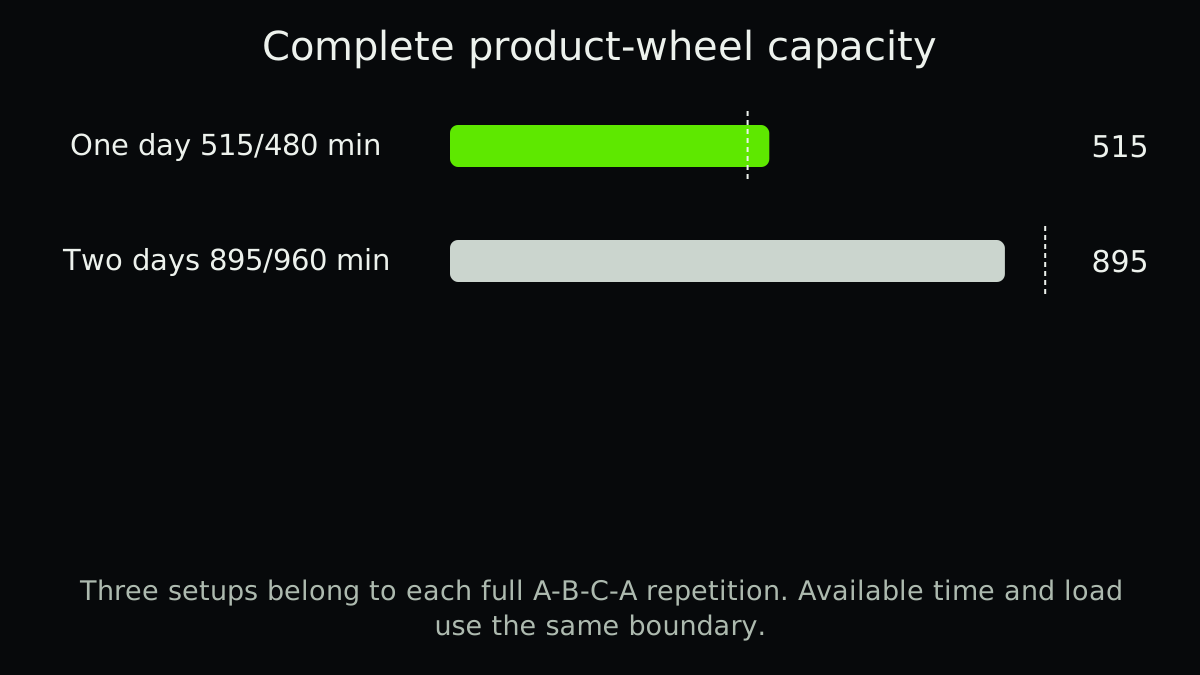
A one-day wheel needs 380 run minutes plus 135 setup minutes, or 515 minutes. It exceeds the 480-minute day by 35 minutes. A two-day wheel runs 200 A, 160 B and 80 C:760 run minutes plus 135 setup minutes =895 minutes within 960 available.
The two-day candidate has 65 minutes unallocated in this simplified model. It still needs a feasible sequence, due-date and stock check. The 1.35-day lower bound is not automatically the chosen schedule: shift boundaries, batch rules and variability can change the practical interval.
Test what a shorter setup actually buys
If a separately validated SMED change reduces each of the three setups to 20 minutes, the cycle uses 60 setup minutes. A one-day wheel then needs 440 minutes and leaves 40 minutes unallocated under the same demand and run assumptions.
This is a conditional planning result, not a measured improvement. Confirm setup definition, startup scrap, cleaning, quality release and operator availability. Saving internal stopped time while moving work to an already-overloaded shared operator may not create the usable capacity assumed here.
- Fix the repeating mix
List products, demand rates, run times and the full cyclic sequence.
- Calculate run and setup load
Include the return setup and losses not already counted.
- Check candidate intervals
Compare complete-cycle load with available time, stock and due dates.
- Validate the chosen wheel
Test realistic variation and changes before fixing the release policy.
Keep inventory and sequence-dependent setups in the decision
Under steady demand, producing every two days generally requires a different cycle-stock pattern from producing daily. Do not claim that shorter repetition eliminates safety stock, minimum batches or demand variability.
If A-to-B takes less time than B-to-A, retain the actual setup matrix. If demand changes, recalculate the wheel instead of preserving its appearance. Use production scheduling for the detailed timing and Kanban sizing for a separate replenishment loop.
Use the wheel as a tested rule, not a decorative chart
Retain the demand revision, time observations, setup matrix and exceptions alongside the chosen interval. Review missed replenishments and late orders to learn whether the rule still fits.
The download includes both candidate wheels and blank fields for demand, run times and the full setup cycle. Check one current family first. The arithmetic is a capacity screen, not a delivery promise.
A related example from Abolfazl
Follow the scheduling decision after a shorter changeover.
In English, on founder Abolfazl’s personal blog. This is related reading, not an independent technical source.
Practical checklist
- Name every product in the interval.
- State demand and available time units.
- Calculate product-specific run load.
- Count every cyclic setup, including the return.
- Keep loss allowances consistent.
- Test sequence, stock and due dates.
- Label proposed setup savings as conditional.
- Recheck the wheel after demand or process changes.
FAQ
FAQ
Sources and further reading
Authoritative references used to research and verify this guide.