
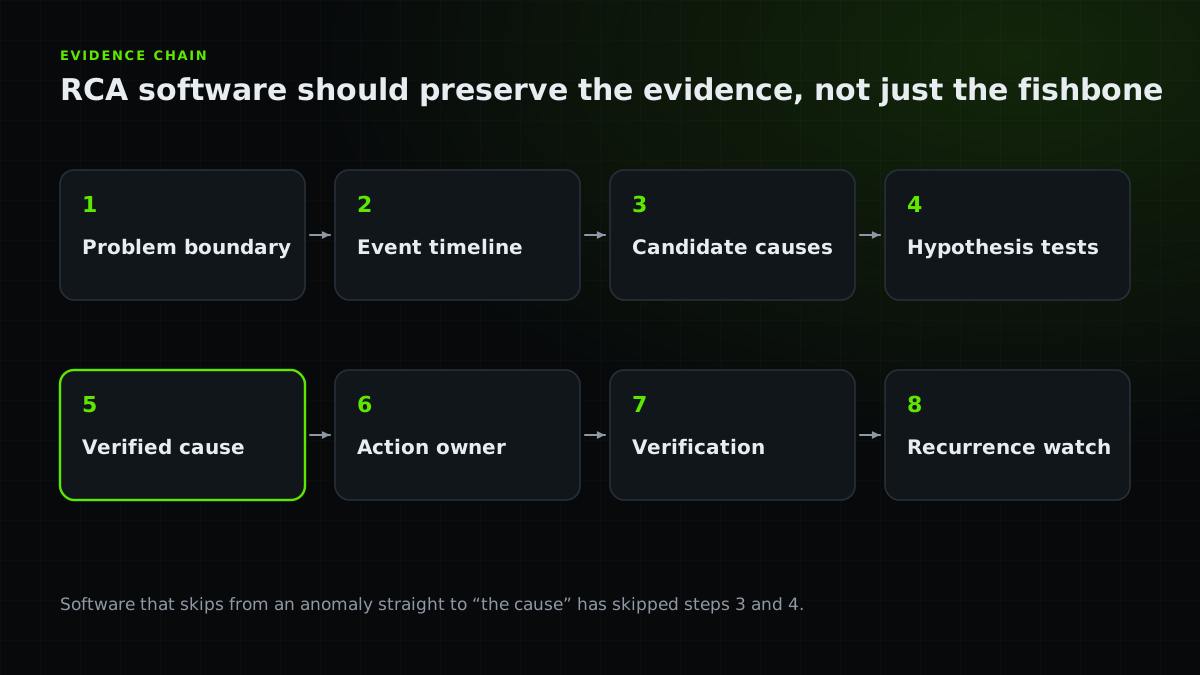
Good root cause analysis software preserves the evidence chain: the problem boundary, an event timeline, candidate causes, hypothesis tests, a verified cause, an owned action, verification and recurrence tracking. A tool that only digitizes a fishbone or a form does not do that. Be wary of software that jumps from an anomaly to “the cause” without showing the competing explanations it tested. Vrolen makes decision-support software, so weigh this guide accordingly.
Five software categories and what each is for
Ten capabilities that separate evidence from decoration
A red flag for AI that names a cause without proving it
The evidence chain an RCA tool should preserve
A root-cause investigation is a chain of claims, each of which needs evidence. Software should hold that chain in a form someone else can audit and reuse. If the record cannot show what was tested and what was ruled out, the next investigation starts from zero.
Five categories of RCA software
Products fall into recognizable groups. Each is right for some situations and weak for others.
| Category | Good for | Limit |
|---|---|---|
| Template and document RCA | Consistent forms for 5-why, fishbone or A3 | Holds conclusions, not evidence |
| QMS and CAPA-integrated RCA | Regulated corrective and preventive action | Workflow-centered; light on production data |
| CMMS-integrated failure investigation | Equipment failures and maintenance history | Narrow scope beyond assets |
| Production-data diagnostic platforms | Timelines and patterns from operating data | May stop at candidates, not verified causes |
| AI-native causal investigation systems | Speeding evidence and similar-case retrieval | Must show tests, not only rankings |
Ten capabilities to require
Use these as a checklist in a trial. Each one corresponds to a step in the evidence chain.
- Event timeline built from machine, quality and maintenance data
- Evidence attachments with lineage: where it came from and when
- A clearly stated problem boundary
- Candidate causes recorded as hypotheses
- Hypothesis testing with the result recorded
- Action ownership with due dates
- Verification against a stated prediction
- Recurrence tracking after closure
- Similar-case retrieval from past investigations
- An audit trail of who changed what
“AI-generated root cause” is a red flag
If software jumps directly from an anomaly to “the cause”, ask four questions. What competing explanations were tested? What evidence would falsify the claim? What changed after the intervention? How was recurrence evaluated? A ranked candidate list is useful. A single confident cause with no tests is a guess. See AI can accelerate RCA but cannot turn correlation into cause.
How to run a fair trial
Give each candidate one real, closed investigation whose cause you already know. See whether it reaches the same answer, and whether the record shows how. Then give it one open problem and check whether the evidence chain is complete enough that a colleague could take over.
Use the existing methods as the standard: root-cause analysis and the A3 define what a good record contains. For the wider software choice, see the analytics buyer’s guide and continuous improvement software.
- Replay a closed case
Does the tool reach the known cause, and can you see why?
- Run an open case
Is the evidence chain complete enough to hand over?
- Probe a false lead
Does it surface confounders or accept a plausible wrong cause?
- Check the follow-up
Are actions owned, verified and tracked for recurrence?
- Test export
Can you take the investigation record with you?
Practical checklist
- Decide which evidence the tool must preserve.
- Check that causes are recorded as hypotheses until tested.
- Require a visible test result for every stated cause.
- Make sure actions have owners and verification dates.
- Confirm recurrence tracking after closure.
- Test similar-case retrieval on a real past case.
- Check the audit trail and export options.
- Treat any single unexplained “cause” as a hypothesis.
FAQ
Questions before you join
Sources and further reading
Authoritative references used to research and verify this guide.