
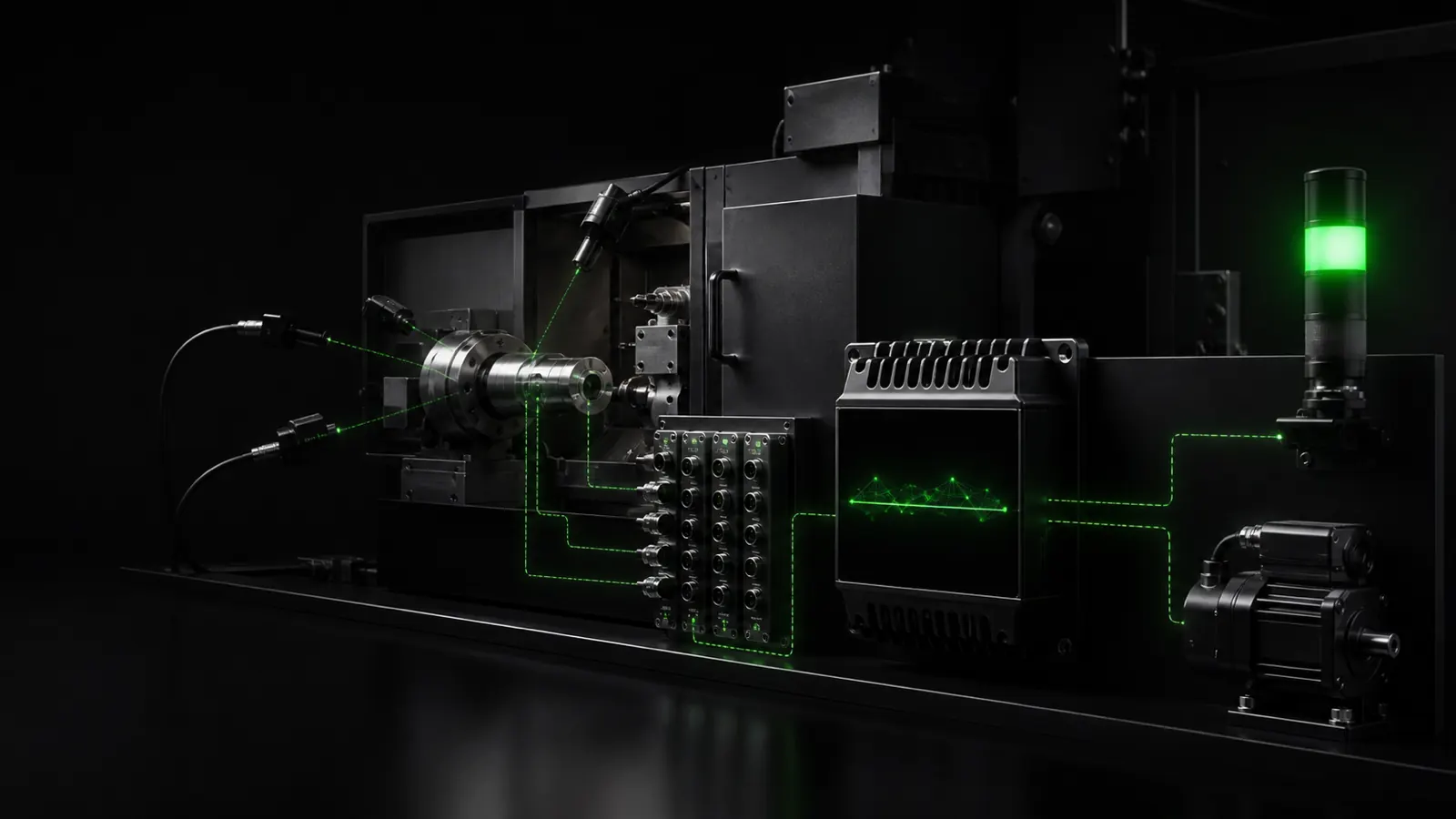
Real-time production monitoring collects and contextualizes machine, process, quality, order, material, and human-response signals quickly enough to support a defined operational decision. “Real time” is not one universal latency: a safety interlock may require milliseconds inside the control system, an Andon response seconds, a downtime escalation minutes, and a production review hours. Value comes from timely action and learning, not from displaying every tag live.
Live signals joined to asset, product, order, and process context
Latency and alarm design matched to the response window
Trusted monitoring connected to diagnosis, escalation, and improvement
Start with the decision and required latency
List the operating decisions: stop or continue, call support, contain product, adjust within approved limits, protect a constraint, reschedule, inspect, or investigate later. Define who owns each decision, evidence needed, acceptable delay, cost of error, and fallback when data is unavailable.
Keep safety and deterministic control in validated control layers. Cloud or enterprise analytics may inform decisions but should not silently become part of a safety-critical loop. The architecture and service target should follow the consequence.
- Decision, owner, and response window
- Signal and contextual evidence
- Allowed action and approval boundary
- Fallback, fail-safe, and escalation
- Retention needed for diagnosis and learning
Build context from edge to enterprise systems
PLC and sensor values need asset identity, engineering unit, state, sample rule, timestamp, and quality. Production meaning also requires order, product, route, recipe, shift, material, tool, quality, maintenance, and schedule context from MES, ERP, QMS, CMMS, or controlled manual inputs.
Preserve raw events where useful and create governed derived states. Document clock synchronization, counter resets, late events, buffering, disconnects, resampling, and transformation versions. An accurate temperature without the correct batch and process phase can support the wrong decision.
Design alarms as response contracts
An alert should identify an actionable abnormality, responsible role, severity, evidence, acknowledgement, expected response, escalation, and expiry. Separate awareness, assistance, containment, and stop conditions. Deduplicate repeated events and suppress only with a governed reason.
Track unanswered alarms, response time, containment time, recurrence, false alerts, stale alerts, and alerts that changed no decision. Alarm volume is not monitoring maturity; it may indicate poor thresholds or missing ownership.
- Detect
Evaluate a trustworthy signal against a defined condition.
- Contextualize
Attach asset, order, product, state, quality, and recent events.
- Route
Send the right severity to a role that can act.
- Respond
Acknowledge, contain, restore, and record the decision.
- Learn
Investigate recurring impact and improve thresholds or process.
Engineer reliability, cybersecurity, and degraded operation
Connected monitoring expands attack surface and operational dependency. Segment networks, use least privilege and managed identities, encrypt appropriate traffic, inventory assets and data flows, monitor access, test recovery, and control configuration changes. Avoid exposing PLCs directly to public services.
Define behavior during network, cloud, gateway, sensor, and time-service failure. Buffer at the edge where necessary, show stale data visibly, and preserve local operation. Test loss and recovery, not only the happy path.
Measure decisions and losses avoided, not screen activity
Validate the monitoring baseline against physical observation and known events. Then track detection delay, context completeness, response, recurrence, false and missed signals, downtime or quality impact, data availability, and the operating cost of the system.
Use historical replay and simulation to test thresholds and staffing before wider release. AI can detect multivariable anomalies, but compare it with transparent rules and monitor drift. A prediction without an action window and responsible owner is only an interesting signal.
A related example from Abolfazl
Check event time, late arrivals and duplicates before trusting a live count.
In English, on founder Abolfazl’s personal blog. This is related reading, not an independent technical source.
Practical checklist
- Define each monitored decision, owner, consequence, and latency.
- Keep safety-critical control in validated control layers.
- Attach asset, unit, state, timestamp, quality, product, and order context.
- Document event transformations, buffering, late data, and clock behavior.
- Design alerts with severity, acknowledgement, response, escalation, and expiry.
- Segment networks, limit access, and test degraded and recovery modes.
- Validate against physical events and representative operating conditions.
- Measure response, recurrence, false signals, and avoided operational loss.
FAQ
FAQ
Sources and further reading
Authoritative references used to research and verify this guide.