
A manufacturing skills matrix records which tasks each person can perform under defined conditions and what training remains. To use it for a shift, compare demonstrated qualifications with tasks needed at the same time. Counting qualified names per column is not enough when one person covers several columns. This fictional four-person example shows a single absence leaving three people for three stations but no feasible assignment, even though every station still has a qualified name.
Separate attendance from demonstrated task qualification.
Test simultaneous coverage rather than column totals.
Choose cross-training that addresses a real assignment gap.
Define what a qualification actually permits
Lean Enterprise Institute’s skills-training matrix distinguishes required and attained skills and includes a training plan. Adapt that purpose to your actual work: identify the task, method revision, conditions and evidence for independent performance.
A simple local scale might distinguish not trained, supervised, independently qualified and approved to train others. Those labels are examples, not a universal certification scheme. A specialist permit or legal requirement cannot be replaced by a colored matrix cell.
Read the qualifications in the fictional shift
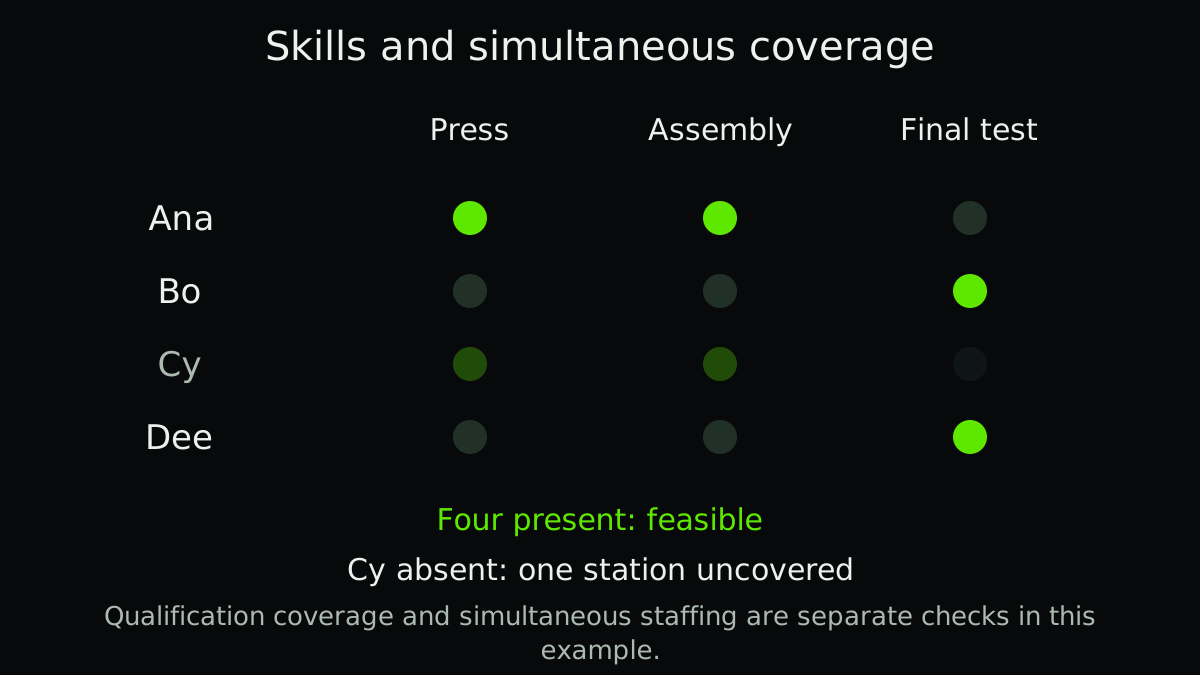
Three stations must operate simultaneously: press, assembly and final test. One independently qualified person is required at each station for this illustrative model; sharing during the same interval is not permitted. Four people are available before an absence.
Ana and Cy can each run the press or assembly. Bo and Dee can each run final test only. The matrix shows independent qualification, not attendance or permission for every product revision.
| Person | Press | Assembly | Final test |
|---|---|---|---|
| Ana | Qualified | Qualified | Not qualified |
| Bo | Not qualified | Not qualified | Qualified |
| Cy | Qualified | Qualified | Not qualified |
| Dee | Not qualified | Not qualified | Qualified |
Test assignments, not just qualified names
With all four present, Ana can take press, Cy assembly and Bo test, leaving Dee as test backup. If Cy is absent, three people remain for three stations. Every station still has a qualified name, but Ana is the only person who can run either press or assembly. She cannot cover both simultaneously.
If Bo alone is absent, Ana can take press, Cy assembly and Dee test, so that assignment remains feasible. The effect depends on which qualification disappears, not simply the number absent.
Three available people and a qualified name in every column still do not prove a complete assignment. Press and assembly both need the same remaining person when Cy is absent.
Train for a useful backup, not a full green sheet
Choose training using the uncovered scenario, task consequence, realistic attendance and time to competence. If Bo becomes independently qualified for assembly, Cy’s absence can be covered by Ana on press, Bo on assembly and Dee on test. This is a proposed training result, not a completed qualification.
If two people are absent, only two remain for three simultaneous one-person stations. No extra qualification creates the missing third person. Separate the skill-flexibility problem from the headcount problem before choosing a response.
- List simultaneous work
State task, product, interval and independent staffing requirement.
- Verify qualifications
Record method revision, assessment evidence and any expiry or restriction.
- Test absence scenarios
Find distinct person-to-task assignments using actual availability.
- Plan the response
Choose approved staffing, training or schedule changes and verify their effect.
Connect skills with the standard work and schedule
Use the standardized-work combination table when one person may safely share tasks at different times. That requires a timing study; it cannot be assumed just to make the staffing spreadsheet balance.
Then use production capacity planning to reflect qualified coverage in available hours. Line balancing distributes work elements, but an apparently balanced station still needs someone qualified and available to run it.
Keep the matrix current without turning it into a ranking
Review changed methods, long gaps in practice, new products and qualification expiry where applicable. Keep the assessment owner and evidence date visible. Let people see the training plan and report constraints; avoid using a simplified coverage sheet as a public league table.
The download includes the fictional matrix and a blank coverage record. Try one realistic absence against tomorrow's tasks before choosing the next training priority. Competence assessment and safe assignment remain the site's responsibility.
A related example from Abolfazl
A founder perspective on carrying standard work and readiness checks into software.
In English, on founder Abolfazl’s personal blog. This is related reading, not an independent technical source.
Practical checklist
- Define each task and method revision.
- Separate training attendance from qualification.
- Record restrictions and assessment evidence.
- Use actual shift availability.
- State which tasks are simultaneous.
- Assign distinct people before counting coverage.
- Choose training for a specific gap.
- Review changes and expiry with the responsible owner.
FAQ
FAQ
Sources and further reading
Authoritative references used to research and verify this guide.