
Control an engineering change by assessing its effect on connected product and process records, approving the required actions and defining exactly where the new revision takes effect. A drawing approval alone does not update tooling, inspection, purchased parts or work already in progress. This fictional bracket revision follows those dependencies and reconciles old stock and WIP. It distinguishes a proposed disposition from completed rework, without treating a change record as proof of product compliance.
Map the production records affected by one revision.
Define effectivity beyond an email approval date.
Reconcile old stock and unfinished work without silently mixing revisions.
Separate the request, approval and effective point
An engineering change request, or ECR, proposes a change and its reason. An approved change order or notice defines what to implement. Effectivity states where the approved change applies, such as a serial range, lot or dated configuration rule. Organization-specific names vary; the decision boundaries still need to be explicit.
NIST’s engineering-change work treats changes as connected decisions across a product lifecycle. NASA’s configuration-management guidance similarly separates control of changes from identifying and recording the actual configuration. Use the applicable site and customer process rather than copying another industry’s authority chain.
Follow a mounting-hole revision into the process
In this illustrative example, bracket revision D changes a mounting-hole location. The customer has not supplied a real requirement; all quantities and dispositions here are teaching assumptions. The team proposes D for serial S1001 onward after approval of the full implementation package.
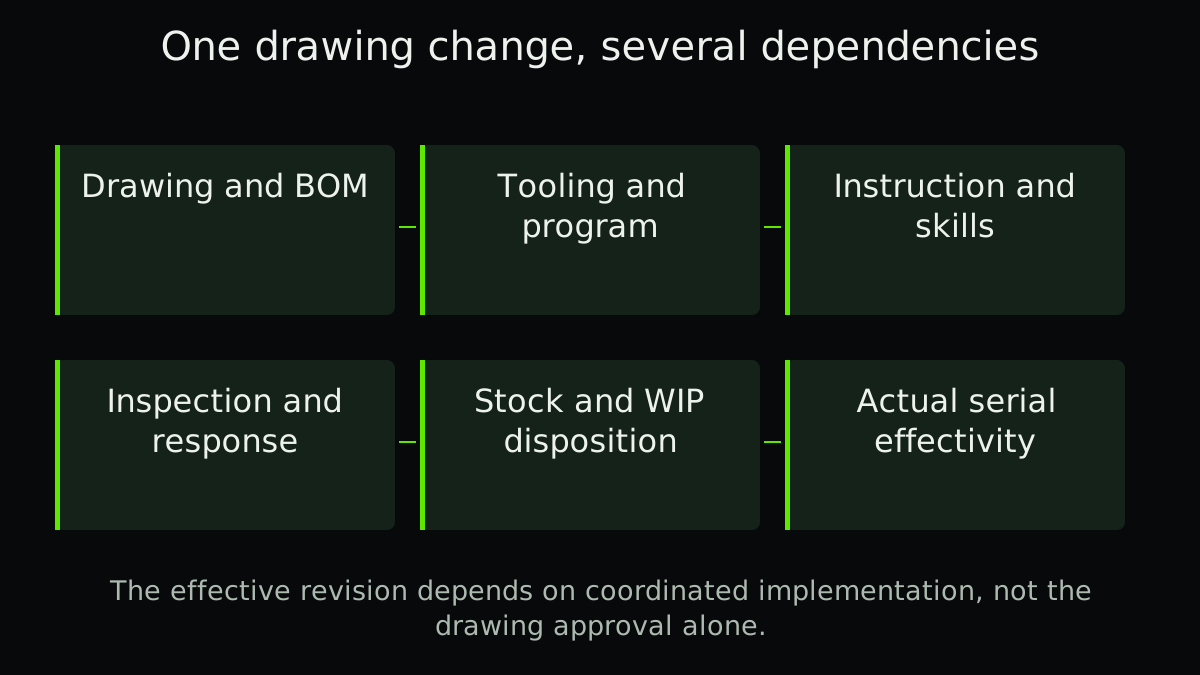
The drawing depends on the bill of materials, fixture, program, work instruction and inspection method. Retaining revision C in one of those places can produce a part that looks like the new revision but was made or checked using old geometry.
| Connected item | Required decision before D is effective |
|---|---|
| Drawing and BOM | Approve geometry, part identity and affected assemblies |
| Fixture and machine program | Verify compatibility and controlled revision |
| Work instruction | Replace the approved point-of-use method |
| Inspection | Update characteristic, reference and verified measurement method |
| Stock and WIP | Approve use, rework, return or scrap for each scope |
| Serial record | Capture the as-built configuration at the effective boundary |
Reconcile the old-revision population
Assume 500 finished C brackets and 120 C brackets in WIP exist at the change snapshot. A proposed authorized disposition would use 300 finished pieces and 80 WIP pieces for eligible old-revision orders. The remaining 200 finished and 40 WIP pieces need an approved rework decision.
The totals reconcile:620 existing pieces =380 proposed old-revision use +240 proposed rework. None of those 240 pieces is already reworked merely because the spreadsheet assigns a route. Record actual completion, inspection and new identity separately.
All 620 pieces remain accounted for. The record is a proposed disposition, not a completed release or rework result.
Plan verification before releasing the new revision
Identify what must be checked after each dependency changes: fit, process capability where appropriate, inspection access, training and safe tooling. A drawing comparison cannot prove that an updated fixture produces the required result.
If rework removes material or changes a safety-related interface, competent engineering and customer approval may be needed. Keep failed or incomplete verification visible. Manufacturing control plans help connect the revised characteristic to checks and responses.
- Define the proposed change
Record reason, affected configuration and the requirement to be satisfied.
- Map dependencies and stock
Identify documents, tools, suppliers, assemblies, finished stock and WIP.
- Approve implementation and effectivity
Name authority, verification criteria, dispositions and the effective serial or lot boundary.
- Verify and record as built
Retain implemented revisions, actual disposition results and product history.
Keep temporary deviations separate from the permanent change
A temporary deviation may permit a defined exception for a limited scope under its own authority. It should not silently rewrite the baseline for every future unit. Record its expiration, affected population and return-to-baseline conditions.
Use lot traceability to follow affected units and FMEA to revisit consequences and controls. These links answer different questions: where the revision went, and what risks the changed process introduces.
Close the change with the production evidence
Before closure, compare the planned impact list with implemented records and unresolved items. Verify that operators and inspectors can access the correct revision. Remove obsolete point-of-use copies through the controlled process, without destroying the historical record.
The download includes the fictional 620-piece reconciliation and a blank impact record. Use it to check that every affected item has an owner, a disposition and evidence of what was actually done. Engineering approval stays with the responsible organization.
A related example from Abolfazl
See why old event quantities must retain the conversion used at the time.
In English, on founder Abolfazl’s personal blog. This is related reading, not an independent technical source.
Practical checklist
- Record the reason and affected configuration.
- Separate request from approved implementation.
- Map tools, programs and documents.
- Snapshot finished stock and WIP.
- Approve dispositions and reconcile quantities.
- Define serial, lot or other precise effectivity.
- Verify actual as-built and inspection records.
- Close unresolved dependencies under named authority.
FAQ
FAQ
Sources and further reading
Authoritative references used to research and verify this guide.