

 Abosh
A project owner estimates cost of delay by comparing the economic consequence of delivering later with delivering sooner over a stated period. Weighted Shortest Job First, or WSJF, compares delay cost with job duration to inform sequencing. SAFe uses relative scores for that comparison. Keep those points separate from money, and check dependencies, mandatory work and constrained resources before deciding which ready job to start.
State what an extra period of waiting actually changes.
Keep relative scores separate from cash estimates.
Find the assumptions that could reverse the next-job decision.
Define the delayed outcome and its clock
The owner names the outcome that becomes available when the work finishes: an avoidable expense removed, an order accepted, a required obligation met or another defined result. The team then estimates what changes if that outcome arrives later. PMI's cost-of-delay discussion begins with this economic objective rather than with the project deadline alone.
Keep the comparison date, delay interval and scope explicit. A week of waiting matters differently before a customer cutoff and after it. The team should retain the evidence for a discontinuity or deadline; a straight line is a declared assumption, not the default shape of every business consequence.
Separate delayed value from the cost of doing the work. An estimate of total project benefit does not establish the loss from postponing it by one week. A named stakeholder and finance owner should confirm what is included and which costs overlap.
Calculate a delay consequence before using a priority ratio
If the team has evidence for a constant avoidable loss rate over the relevant interval, multiply that rate by the delay. Use matching time units. When the rate changes with time, compare the two dated outcome estimates or add the distinct period losses instead of extending a constant rate beyond its evidence.
The existing downtime-cost guide demonstrates why lost revenue, lost contribution and extra recovery expense differ. Reuse its accounting boundary when a project targets stoppages, but do not turn one hour's conditional loss into a measured weekly project delay cost.
ACCA's relevant-cost guidance helps separate future consequences changed by a decision from sunk expenditure and unchanged accounting allocations. Record genuine opportunity costs separately and avoid counting the same lost sale both as revenue and as contribution.
Use this multiplication only while the stated loss rate and outcome assumptions hold. Missing loss or timing evidence leaves the estimate unknown.
Keep SAFe's relative WSJF score in its own units
SAFe defines WSJF as relative cost of delay divided by relative job duration. Its public description estimates the numerator from relative user/business value, time criticality and risk reduction or opportunity enablement, then uses job size in the comparison.
The team scores a comparable set of candidate jobs on a consistent scale. A higher resulting score favors earlier sequencing under that model. It does not establish a monetary return, a probability of success or a universal priority across unrelated teams.
Keep the evidence and uncertainty beside each component. Do not add a cash amount to a relative time-criticality score, compare points assigned on different scales, or present a score as an independently measured customer benefit.
The denominator must be positive. Relative points are not currency. Apply one consistent scoring convention to the compared jobs.
An existing capacity plan cannot supply missing delay costs
The existing improvement-portfolio guide describes thirty projects competing for one engineer. A separate capacity example in that guide gives one specialist 12 hours per week and four hours per active project. Its two-project trial reserves four hours. These are fictional teaching inputs.
Those quantities do not provide a delay-cost rate or an elapsed completion time for either project. Four hours of specialist effort may span a longer calendar interval when the team needs materials, approval or another resource. Dividing an invented benefit by four would manufacture a priority score.
The accompanying blank record therefore leaves delay cost, relative scores, elapsed duration and chosen order empty. The reader can identify what evidence the team still needs. The existing arithmetic supports a capacity check: two projects use eight specialist hours and leave four of the twelve reserved.
Test the assumption that would change the order
For two positive monetary loss rates a and b and two positive durations A and B, compare a/A with b/B only under the stated constant-rate, ready-job and sequencing assumptions. The first ratio exceeds the second when a/b exceeds A/B. This is an algebraic boundary, not a manufactured factory result.
Record a defensible low and high estimate for each uncertain input. Recalculate both orders at those bounds. If the preferred job changes, show the switching condition to the decision owner and identify which missing fact would narrow it. If the ranges overlap, report that the score alone cannot settle the choice.
Do not combine a relative numerator with a monetary one in this calculation. A team using SAFe points should vary its relative estimates consistently; a team using money should retain its dated cash assumptions and the meaning of duration.
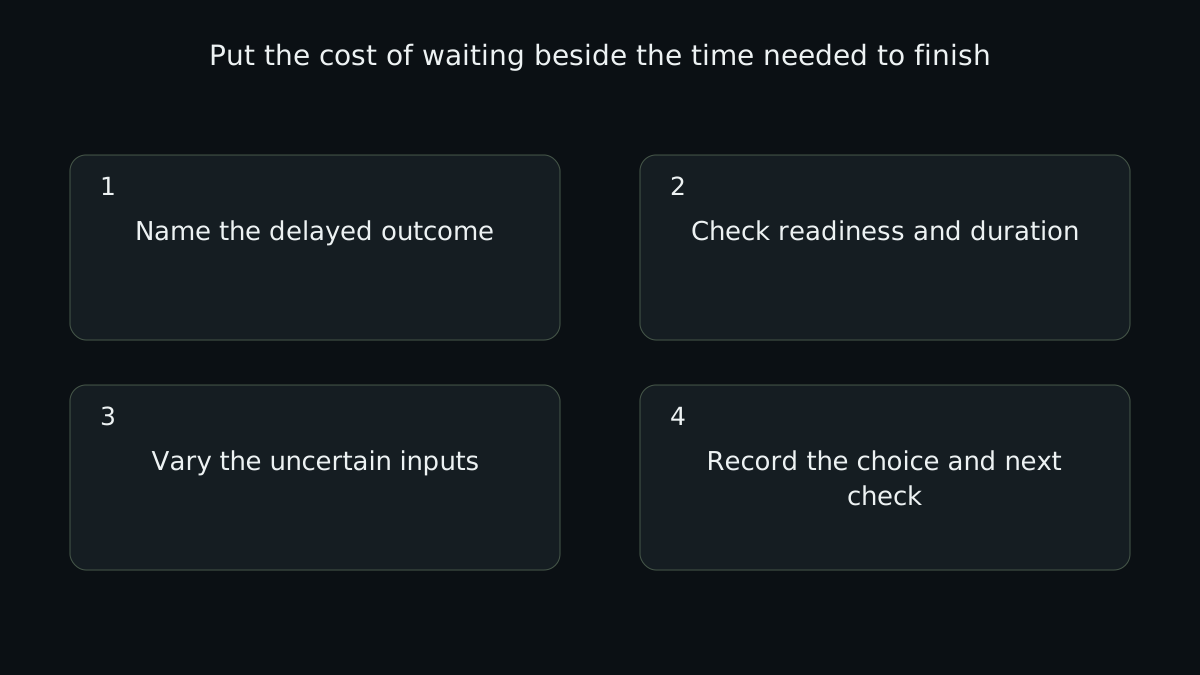
- Name the delayed outcome
The owner records the changed consequence and the period over which it applies.
- Check readiness and duration
The team confirms dependencies and estimates elapsed completion using available resources.
- Vary the uncertain inputs
The reviewer checks whether supported low and high estimates change the preferred order.
- Record the choice and next check
The decision owner retains the assumptions, exceptions and date for reconsidering them.
Apply the score within the work the team can do
The team first separates mandatory safety, regulatory and contractual work requiring a specific decision path. A convenient score cannot waive those duties. It then checks which discretionary jobs are ready, which depend on others and which compete for the same constrained resource.
The project-flow guide explains why starting more work can lengthen the queue. A priority ratio cannot create specialist capacity or remove an approval dependency. Use the selected order within the portfolio's release limit, then review it when readiness, duration or the cost of waiting changes.
If a Vrolen comparison represents those queues and resource rules, the team can inspect a proposed release order against a checked baseline. Such a model tests the stated assumptions; it cannot certify the business value used in the score or guarantee an optimal real-world schedule.
Bring the disputed input to the decision meeting
Complete the priority record for the jobs actually competing for the next release. Keep the owner, source, range and update date beside every estimate. Leave unknown values blank instead of converting uncertainty into zero.
If the preferred order depends on a duration nobody has checked, resolve that duration before refining the decimal places. Record what the team started, what it held and which observed result will trigger the next review.
A business-case example from Abosh
Check the evidence for a project's costs and benefits before estimating the consequence of delivering it later.
In English, on founder Abosh's personal blog. The case supports investment reasoning; it does not supply observed WSJF scores or delay costs for this article.
Practical checklist
- Name the outcome and comparison date.
- Specify the delay interval and economic boundary.
- Separate conditional consequences from expected value.
- Keep monetary inputs and relative scores apart.
- Estimate elapsed duration, not just specialist effort.
- Check readiness, dependencies and mandatory work.
- Test supported input ranges and switching conditions.
- Record the owner, release decision and next check.
FAQ
FAQ
Sources and further reading
Authoritative references used to research and verify this guide.