

 Abosh
A launch team uses Advanced Product Quality Planning, or APQP, to plan and coordinate product and process readiness. Production Part Approval Process, or PPAP, brings the required production evidence to the customer's approval decision. The Part Submission Warrant, or PSW, summarizes the supplier's submission; it is one element of that evidence. Keep the applicable customer instructions, part revision and production conditions attached to all three.
Distinguish planned checks, completed evidence and customer approval.
Connect risks and control records to the same part and process revision.
Find missing ownership before sending an approval package.
APQP plans the work that PPAP must support
Engineering identifies what the part must do. Production develops the route. Quality defines how the team will check the result. APQP connects those activities before launch and keeps unresolved risks visible as the design and process develop.
AIAG's public PPAP description focuses on meeting design and specification requirements during an actual production run at production rates. A complete-looking folder cannot establish that result if its measurements came from another revision or from an unrepresentative process.
The supplier prepares the PSW after checking the supporting evidence. The customer then applies its approval process. Keep supplier declaration, submission and customer disposition as separate statuses; sending the warrant does not by itself authorize shipment.
Read the five phases with the current edition
AIAG's current catalog lists APQP third edition. Its 2024 revision separates Control Plan into a first-edition manual and adds material on sourcing, change management, risk and gated management. The public AIAG implementation course still describes five APQP phases. A program's approval gates and phase numbers need not be the same count.
The phase names below follow the AIAG-oriented sequence shown in the public TopQM AIAG Automotive Days presentation. The questions are our reading guide, not copied AIAG checklists. Teams may overlap activities; they still need evidence before accepting each handoff.
| Phase | Check before the handoff |
|---|---|
| Plan and define the program | Have customer needs, scope and feasibility been recorded? |
| Product design and development | Can the team trace requirements to design verification? |
| Process design and development | Do the route, risks, controls and measurement methods agree? |
| Product and process validation | Does evidence represent the intended production conditions? |
| Feedback, assessment and corrective action | Who resolves launch findings and updates the controls? |
The submission level controls what goes to the customer
The familiar five PPAP levels describe evidence submission and review arrangements. Fideltronik's public 2019 supplier manual reproduces this grouping under AIAG PPAP fourth edition. That dated public copy illustrates the distinction; obtain the current controlled instructions for your own contract.
The customer determines the applicable level and additional requirements. A smaller submitted package does not establish that other applicable work can be omitted. Record which evidence must be sent, retained or reviewed and who accepted that interpretation.
| Level | Submission or review arrangement |
|---|---|
| 1 | Warrant, plus an appearance report where designated |
| 2 | Warrant, samples and limited supporting data |
| 3 | Warrant, samples and complete supporting data |
| 4 | Warrant and requirements defined by the customer |
| 5 | Warrant, samples and complete data reviewed at the manufacturing location |
Use the eighteen elements to locate evidence
AM General's publicly available November 2023 supplier manual maps its PPAP requirements to eighteen AIAG elements. The grouped list below identifies those record types. It does not replace applicability decisions, licensed instructions or customer-specific requirements.
Keep design records; authorized engineering changes; customer engineering approval; design FMEA; process flow; process FMEA; control plan; measurement-system studies; dimensional results; material and performance-test results; initial process studies; qualified-laboratory documentation; appearance approval; sample production parts; master sample; checking aids; customer-specific requirements; and the Part Submission Warrant.
For each applicable record, identify the requirement source, owner, revision and actual evidence. An absent result remains open. A signed cover sheet cannot supply the missing measurement.
Carry the same requirement through the handoff
The existing control-plan guide uses a fictional fastener requirement of 8.0 ± 0.5 N m. Keep that teaching assumption unchanged. The guide also calculates a potential two-hour suspect population at 120 units per hour. Neither quantity establishes that a customer approved the part or that the measurement method is capable.
Engineering owns the stated requirement and revision. The process team links the joint to its risk analysis and control plan. Quality attaches the approved measurement method and actual results. The submission owner reconciles those references before requesting a customer disposition.
A change to the tool, route or part revision can leave old evidence attached to the wrong process. Use the existing engineering-change guide to control effectivity and old stock. The approval record must identify which configuration its evidence covers.
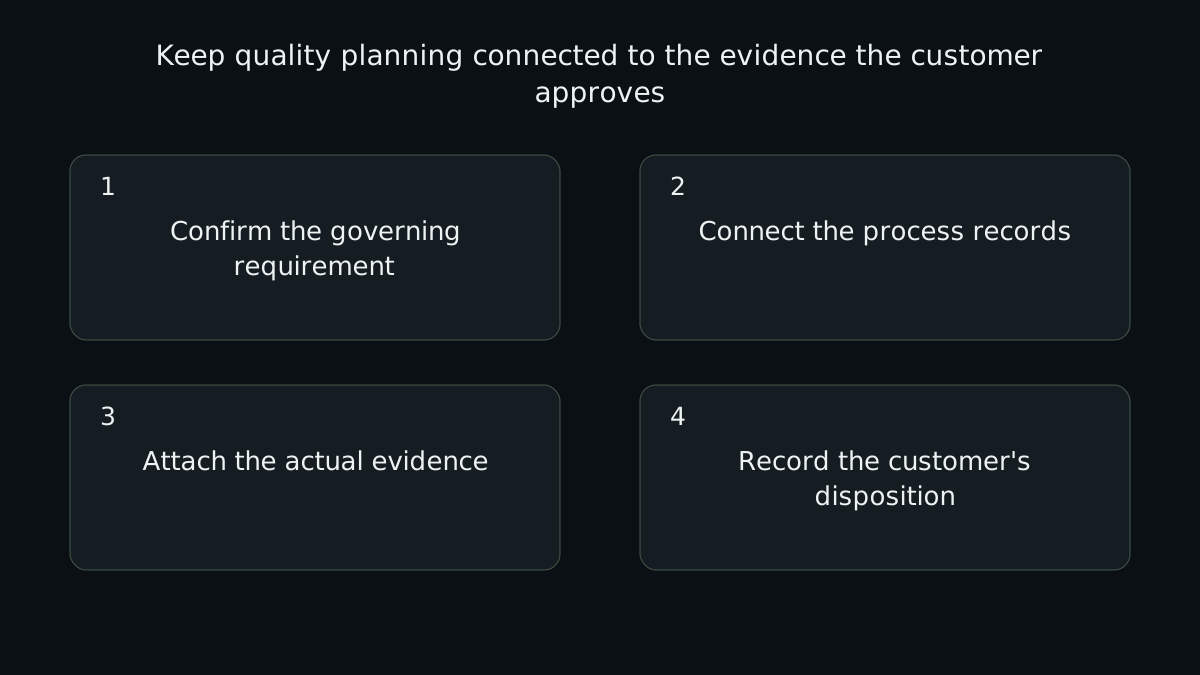
- Confirm the governing requirement
Engineering records the part, revision, characteristic and customer instruction.
- Connect the process records
Production and quality align the route, risk analysis, control plan and measurement method.
- Attach the actual evidence
The evidence owner records the run conditions, results, exceptions and unresolved items.
- Record the customer's disposition
The submission owner retains the decision, scope, restrictions and required next action.
FAI verifies a different approval task
First article inspection, or FAI, documents verification that a production process has produced an article meeting its applicable design requirements. IAQG's 9102 overview places it in aviation, space and defense, with possible use elsewhere. SAE's public AS9102C scope states that its requirements complement customer and applicable statutory or regulatory requirements.
PPAP addresses a production-part approval process with the required supporting records. FAI is not an interchangeable name for that complete submission. A dimensional inspection report alone does not establish either customer's entire approval requirement.
SAE lists AS9102C as revised in June 2023. Use the applicable revision and contract. Do not reuse a revision-B FAQ as proof of a revision-C obligation, or assume that a customer asking for a first article has requested AIAG PPAP.
Keep certification, customer rules and improvement methods distinct
Automotive teams commonly use APQP and the quality core tools in work governed by IATF 16949 and customer-specific requirements. IATF's public directory separately lists OEM IATF and PPAP requirements, including Ford documents effective June 2026. Determine the actual applicable clauses and customer instructions before declaring conformity.
ISO 9001 addresses a quality management system across sectors. Its public overview does not make the AIAG manual an automatic requirement for every organization. ISO now lists ISO 9001:2026 as published; a supplier must still check its certification and customer transition arrangements rather than infer an immediate contract change from that catalog entry.
APQP is not a phase of Six Sigma. A team can use statistical and problem-solving methods within quality planning, but a DMAIC project does not replace the customer's product and process approval evidence. Keep method selection separate from the approval authority.
Build a checklist from the applicable requirements
An APQP checklist records the required work, responsible owner, due point, evidence and disposition for the actual program. Use the blank handoff record below to find missing decisions. It is an original working aid, not an official AIAG form or a declaration of compliance.
Before the next review, choose one unresolved characteristic. Follow it from the requirement through the process, measurement and submission records. Ask the owner to resolve the first missing reference before collecting more presentation slides.
A launch-readiness example from Abosh
Read how product, process and operational readiness meet at a launch decision, then return to the quality evidence required here.
Read the product-introduction note
In English, on founder Abosh's personal blog. Related teaching material does not replace customer approval requirements.
Practical checklist
- Identify the governing customer instructions and editions.
- Record the part and process revision.
- Connect requirements, risks, controls and measurement methods.
- Separate planned tests from actual results.
- Identify the required submission level and retained evidence.
- Keep open items and deviations visible.
- Retain the customer's disposition and restrictions.
- Recheck affected evidence when the process changes.
FAQ
FAQ
Sources and further reading
Authoritative references used to research and verify this guide.
- AIAGAPQP third edition and separate Control Plan manual
- AIAGFive-phase APQP implementation course scope
- TopQM AIAG Automotive Days Europe 2025Public APQP and Control Plan presentation
- AIAGPPAP fourth edition purpose and catalog
- FideltronikPublic supplier manual, 2019, submission-level grouping
- AM GeneralSupplier quality manual, November 2023, PPAP evidence elements
- SAE InternationalAS9102C public scope and revision record
- International Automotive Task ForceCurrent customer-specific requirement directory
- ISOISO 9001 public scope and current edition
- IAQG9102 first article inspection public scope