
 Abosh
Total productive maintenance, or TPM, involves the people who operate, maintain and support equipment in preventing recurring losses. It combines daily care, planned maintenance, focused improvement and supporting practices rather than assigning every fault to the maintenance department. Start with a defined asset and loss, agree who may do which tasks and keep the response connected to its outcome. OEE can describe equipment losses; it does not by itself organize the work or prove that a cause was removed.
Understand the eight TPM pillars without treating them as eight separate campaigns.
Separate restoration, routine care and verified prevention.
Build an abnormality record with a responsible owner and outcome check.
TPM needs shared responsibility with clear limits
The Japan Institute of Plant Maintenance describes TPM as a production-system approach to preventing losses, involving people across functions. Lean Enterprise Institute also emphasizes participation, equipment losses and the equipment life cycle. A clean machine and a completed checklist are useful only when they support the required operation.
Focused improvement, often associated with Kaizen, is part of that work. TPM is not a synonym for a Kaizen event or Six Sigma project. A recurring equipment problem may need direct observation, a maintenance task, a measured investigation or a design change. Choose the method from the failure and consequence.
The eight pillars cover different jobs
JIPM’s eight-pillar description groups direct loss-reduction practices with training, safety and wider supporting work. Use the named model to organize responsibilities; do not turn its zero-loss aims into a promise that equipment will never fail. Some supporting arrangements vary by company.
| Pillar | Practical question |
|---|---|
| Focused improvement | Which recurring loss needs a checked countermeasure? |
| Autonomous maintenance | What approved care and abnormality detection can operators perform? |
| Planned maintenance | Which tasks and intervals address the relevant failure? |
| Quality maintenance | Which equipment conditions affect product requirements? |
| Education and training | Who can perform the task and recognize a problem? |
| Safety, health and environment | Which controls protect people and the environment? |
| Early equipment management | What should the next equipment design learn from current problems? |
| Office TPM | Which planning and support delays keep losses recurring? |
OEE describes a loss; TPM organizes a response
OEE loss analysis distinguishes availability, performance and quality loss under defined clocks. TPM can use those observations to select and verify work. A higher machine score does not automatically mean the value stream delivers more good output.
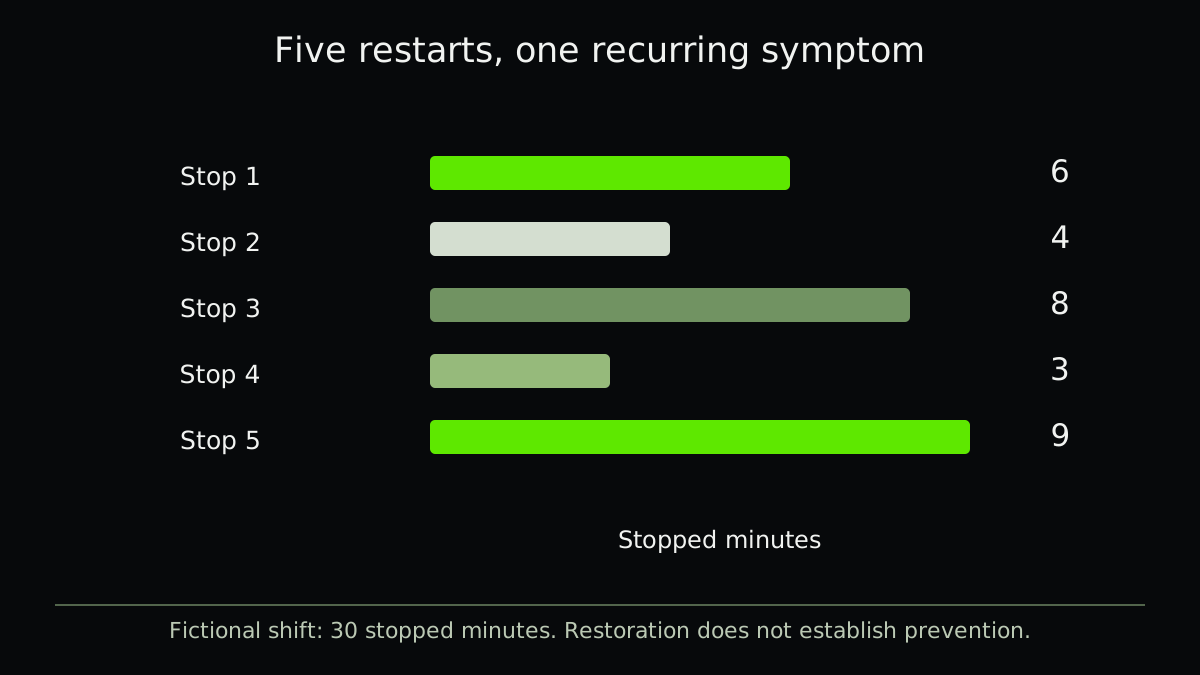
In a fictional shift, the same conveyor fault causes stops lasting 6, 4, 8, 3 and 9 minutes. The recorded stopped time is 30 minutes across five events. Each restart restores operation, but five restart records do not show that the recurring mechanism was removed.
| Fictional stop | Stopped minutes | What the record establishes |
|---|---|---|
| 1 | 6 | Operation was interrupted |
| 2 | 4 | The symptom returned |
| 3 | 8 | Another restoration was needed |
| 4 | 3 | The recurrence remained |
| 5 | 9 | Total observed stopped time reached 30 minutes |
A daily-care checklist needs an abnormality route
List the approved observation or care task, safe condition, frequency, responsible role and response to an abnormal result. A vague “inspect machine” entry gives neither a clear check nor a useful escalation. The downloadable record helps name those fields; it does not prescribe a machine-maintenance procedure.
Operators should perform only tasks covered by their training, authorization and site procedures. Access, isolation, guarding, cleaning and adjustment need the applicable safety controls. Never remove a guard or work on energized equipment because a general TPM checklist suggests it.
A raised abnormality needs an owner, priority and visible disposition. Record temporary containment separately from permanent action. Otherwise the same note can move from one shift sheet to the next without changing the condition.
Choose the maintenance task from the failure
A sensor does not make every fault predictable. A calendar replacement is useful only when the failure and task justify that timing. Reliability-centered maintenance examines function, failure consequences and suitable actions; predictive maintenance adds its own detection and response validation.
The US Department of Energy’s operations and maintenance guide distinguishes maintenance approaches rather than prescribing one for every asset. Keep the failure mechanism and evidence with the task choice. An attractive monitoring dashboard cannot supply a missing safe response window.
- Name the recurring loss
Retain the asset, event boundary, exposure and required output.
- Confirm the current condition
Observe with qualified people and separate the symptom from a proposed cause.
- Choose an authorized response
Specify care, investigation, maintenance or design work with its owner.
- Check effectiveness
Review recurrence, product quality and useful output over representative operation.
Measure what stayed fixed
Keep loss minutes, recurrence, repair delay, overdue abnormalities and relevant product failures beside checklist completion. Record whether the trial saw the condition that used to trigger the problem. Zero failures in a quiet week is weak evidence if the difficult product did not run.
Begin with one asset or connected loss where the team can learn. Carry the verified response into its work standard and maintenance plan. Extend it only after checking whether the next asset has the same mechanism and operating conditions.
A related example from Abolfazl
Use a recurring conveyor fault to separate restoration from prevention.
In English, on founder Abolfazl’s personal blog. This is related reading, not an independent technical source.
Practical checklist
- Choose a defined asset, function and loss.
- Retain event duration and operating exposure.
- Separate repeated symptoms from confirmed causes.
- Agree operator and maintenance task boundaries.
- Use only trained, authorized and safely controlled tasks.
- Give every abnormality an owner and disposition.
- Check recurrence, quality and useful output together.
- Update the standard only after the result is verified.
FAQ
FAQ
Sources and further reading
Authoritative references used to research and verify this guide.