

A designed experiment changes selected factors according to a planned run structure so their effects, interactions and uncertainty can be studied. A two-factor full factorial tests every combination of two chosen levels. Replication and randomized run order help separate the treatment effects from experimental variation and time-related changes. This fictional seal-strength example calculates an interaction that a one-setting-at-a-time trial could miss, without claiming that eight demonstration results identify a production optimum.
Read a two-factor interaction in ordinary process terms.
Reproduce the cell means and main effects.
Plan repeat runs without treating repeated readings as independent trials.
Choose the response and safe factor ranges first
The response is the quantity you want to understand. Here it is seal strength in newtons. Factor A is a low or high temperature setting; factor B is a short or long dwell setting. The labels describe fictional approved trial levels, not operating recommendations.
NIST defines a full factorial as testing every combination of selected levels. With two factors at two levels, that means four treatment combinations. Decide ranges with process and safety experts, check measurement suitability and hold the material definition and response method clear. Gage R&R may help investigate measurement variation before the trial.
Use separate trials at every combination
Our illustrative record has two independently prepared trial runs at each combination. The table is arranged for reading, not execution. A proposed randomized order of run IDs 3,1,8,5,2,7,4,6 is retained in the download; real restrictions may require blocks or a different design.
Two repeated readings of the same seal are not two independent process trials. Record lot, time, operator, machine state and any run restriction. If warming, tool changes or lots impose structure, account for it rather than pretending the experiment was fully randomized.
| Run IDs | Temperature A | Dwell B | Strengths N | Mean N |
|---|---|---|---|---|
| 1,2 | Low | Short | 50,52 | 51 |
| 3,4 | High | Short | 54,56 | 55 |
| 5,6 | Low | Long | 52,54 | 53 |
| 7,8 | High | Long | 66,68 | 67 |
Read the interaction before recommending a setting
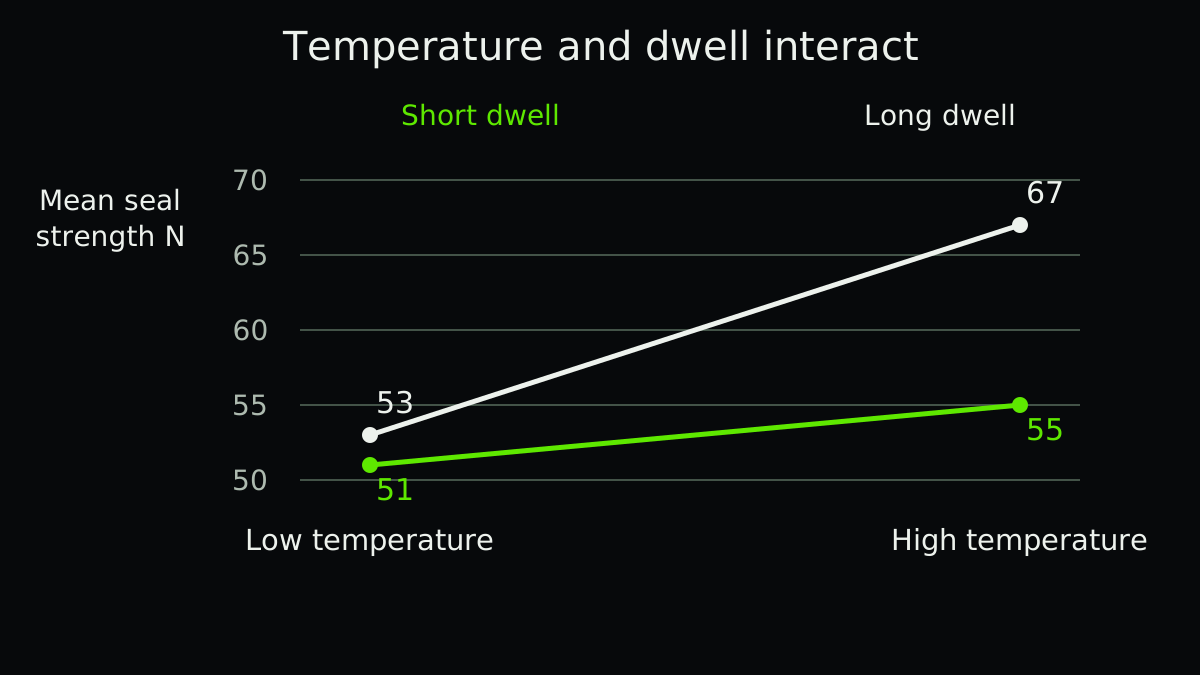
At short dwell, moving temperature from low to high changes the mean by 4 N:55−51. At long dwell, the same temperature change adds 14 N:67−53. The temperature effect therefore depends on dwell. That is the operational meaning of an interaction.
Across the balanced design, the main temperature effect is 9 N: the high-temperature mean 61 minus the low-temperature mean 52. The main dwell effect is 7 N. With the usual−1/+1 coding, the AB interaction effect is 5 N and its fitted-model coefficient is 2.5 N. State the convention; a difference of simple effects is 10 N, not 5 N.
Simple A effects are 4 N and 14 N. Their difference is 10 N; the factorial interaction effect is half that difference.
Estimate variation and examine the model
The eight observations leave 4 degrees of freedom for within-combination residual variation after fitting an intercept, A, B and AB. The within-cell sum of squares is 8 N², giving a mean square of 2 N². This arithmetic is a teaching check, not a process qualification.
Inspect residuals, unusual runs, independence and measurement limits before interpreting inference. A two-level model does not establish curvature between or outside the chosen settings. NIST notes that center points can detect curvature but do not themselves fit a full quadratic surface.
- Define the engineering question
Choose the response, factors, safe ranges and conditions that would change a decision.
- Design the run structure
Plan independent replication, order, blocks and record fields before collecting results.
- Analyze effects and uncertainty
Check interactions, residuals, assumptions and practical consequences together.
- Confirm a candidate condition
Run an approved confirmation under representative conditions before changing routine production.
Keep the strongest seal separate from the best process
Higher strength is not automatically the objective. A seal can have an upper functional limit, damage the package or slow the line. Add the relevant quality, throughput and energy constraints before choosing a candidate setting.
Do not extrapolate beyond the tested region or copy the fictional factor levels into equipment. Use PDCA to connect the trial prediction, result and next decision. DOE supplies a design and analysis method inside that learning cycle.
Retain the run record, including surprises
The download contains the eight fictional responses, treatment labels and proposed order, plus blank fields for a real study. Preserve changes, exclusions and deviations with reasons. A tidy final mean cannot recover a missing material change.
Treat the result as a reason to plan the next trial, not permission to change a production setting. A small experiment needs confirmation under the conditions that matter on the line.
A related example from Abolfazl
Follow an overfill problem from definition to a controlled improvement.
In English, on founder Abolfazl’s personal blog. This is related reading, not an independent technical source.
Practical checklist
- State the response and unit.
- Approve safe factor levels.
- Check the measurement method.
- Distinguish independent trials from repeat readings.
- Plan order and blocks before running.
- Inspect interactions before averaging effects.
- Check residuals and model limits.
- Confirm the candidate under representative conditions.
FAQ
FAQ
Sources and further reading
Authoritative references used to research and verify this guide.